TL;DR
Noryangjin Fisheries Wholesale Market is Seoul’s biggest seafood market, beside Noryangjin Station on Line 1 (dark blue) and Line 9 (gold). You buy live fish, crab or shellfish from stalls on the first floor, then carry it upstairs where a restaurant slices or cooks it for a table fee of about 5,000 to 10,000 won a person. Budget 35,000 won and up per person.
Last checked: 13 Oct 2026 What is a Beep Check?
Sunbae Says: Decide your budget and your fish before you walk in. Noryangjin rewards people who know what they want and punishes people who browse with their wallet out.
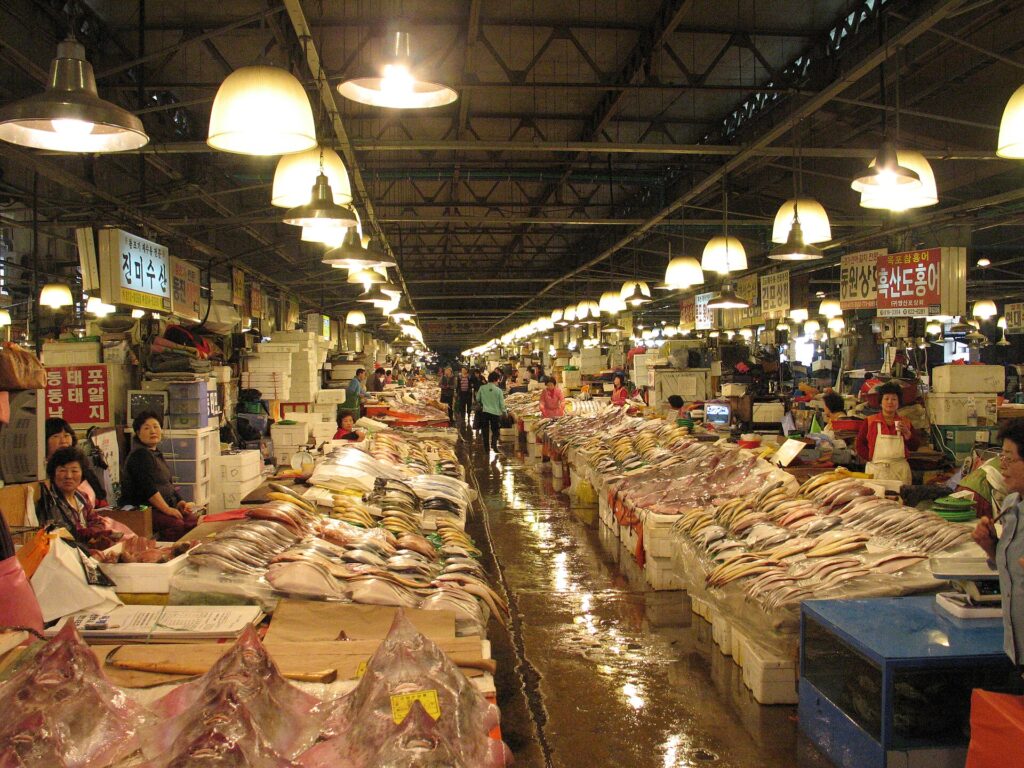
Picture it: a hall the size of a hangar, a wet floor, lit tanks of swimming fish, and three sellers calling out to you at once. It is one of Seoul’s great food experiences, and the place first timers most often overpay. Here is how it works.
How The System Works
The building is two businesses stacked on top of each other. According to the market operator’s own floor plan (in Korean), the first floor holds the auction hall and the retail stalls: live fish, shellfish, fresh fish and frozen seafood. The second floor has a row of seafood restaurants along the north side, plus dried fish, salted seafood, a Suhyup bank and a convenience store. Two more restaurants sit on the fifth floor.
Step by step:
- Choose on the first floor. Pick a stall, point at the fish, agree a price. Live fish are sold by weight (per kg) or as a set platter for one or two people.
- Watch it weighed and cut. The seller nets the fish, weighs it, and usually slices it into hoe (raw fish) for you on the spot, or bags crab and shellfish live.
- Go upstairs. Take your bag to a restaurant on the second or fifth floor.
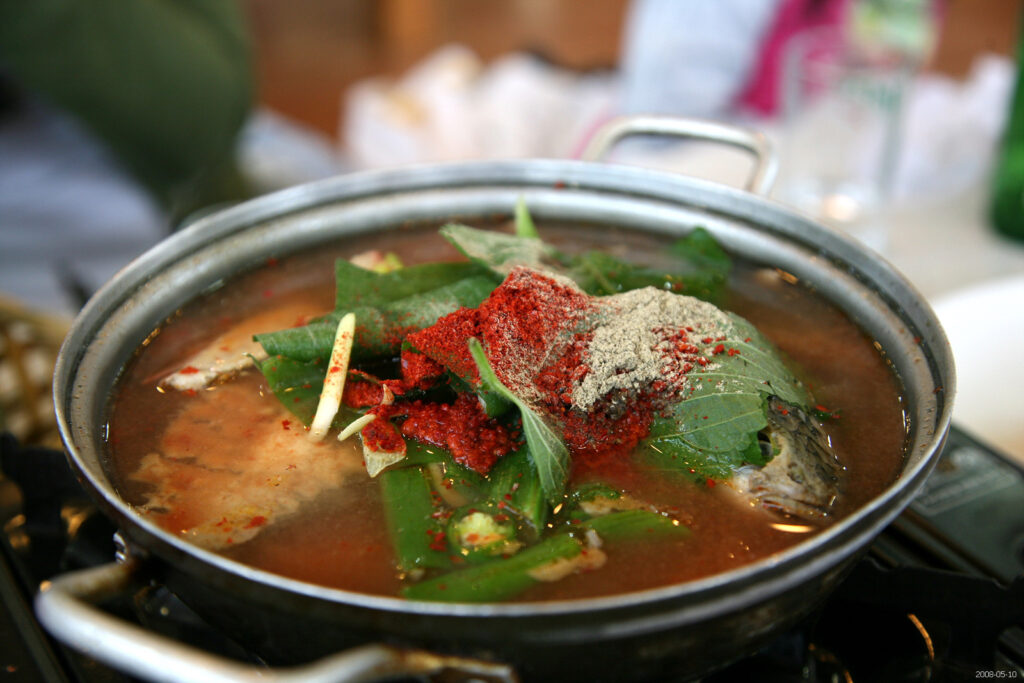
- Pay the table fee. The restaurant charges a sangcharim (상차림) fee per person for the table setting: lettuce, garlic, chilli, chojang (초장, sweet sour chilli sauce), soy and wasabi, and side dishes. Maeuntang (spicy fish stew made from your fish’s bones and head) costs extra or is bundled in.
- Order drinks and rice there. Soju, beer and rice come from the restaurant.
Visit Seoul sums it up: you pay the fishmonger for the fish and the restaurant for the setting.
What It Costs In 2026
The table fee. On the October 2026 DiningCode listing for Haneulchae (하늘채), a fifth floor restaurant, the sangcharim fee is 5,000 won a person, plus maeuntang at 10,000 won for two (5,000 won each); without maeuntang the fee goes up to 8,000 won a person. Jinju Sikdang (진주식당), also on the fifth floor, lists a 10,000 won per person setting that includes maeuntang. So for two people, expect 16,000 to 20,000 won before drinks.
The fish. Prices move daily with the catch. In a March 2025 Siksin round up on Daum (in Korean), first floor stall Hyeongje Sanghoe (형제상회) priced a mixed raw fish platter at 35,000 to 65,000 won for one and 60,000 to 100,000 won for 1.5 to 2 people, and Jeolla Sanghoe (전라상회) listed a premium mixed platter for two at 65,000 won. My estimate for two people in 2026, fish plus table plus stew plus a couple of drinks: roughly 90,000 to 140,000 won.
Crab is the budget breaker. King crab and snow crab sell by the kilo and steaming is usually charged per kilo on top. Korean wiki summaries put crab steaming at about 8,000 won per kg; confirm the steaming fee with the restaurant before you hand it over.
A Short History
The market began in 1927 as Gyeongseong Susan, near today’s Seoul Station, and moved to Noryangjin in 1971, according to Wikipedia. The fisheries cooperative federation Suhyup took over in 2002. Its modernisation project, building the current market beside the old one, ran from 2007 to 2021, reports Hyundai Haeyang (in Korean).
It was not a smooth move. Many old market merchants refused to relocate, and the courts tried repeatedly to evict them: Newsis covered the fourth failed attempt (in Korean) in October 2018, when about 300 court officials pulled back after two hours of standoff. The old site now hosts temporary sports pitches while Suhyup plans a redevelopment.
Where To Eat In The Market
Hyeongje Sanghoe (형제상회), 1F stalls 168 to 172. A first floor seller known for kiosk style fixed pricing. The Siksin list gave Monday to Thursday 10am to 9pm and Friday and Saturday 10am to 10:30pm, with one person platters from 35,000 won (2025 prices).
Jeolla Sanghoe (전라상회), 1F stalls 160 to 161. Another fixed price stall, 9am to 9pm in the same list, with a premium mixed platter for two at 65,000 won (2025).
Haneulchae Main Hall (하늘채 본관), 5F. A table fee restaurant: 5,000 won a person plus maeuntang, or 8,000 won without stew; daily 10am to 10:30pm on its October 2026 listing. Phone 0507-1388-7925.
Jinju Sikdang (진주식당), 5F. Takes your fish for a 10,000 won per person setting with stew, and also sells its own platters (70,000 won for two). Listed hours 11:30am to 11:30pm, last order 10:30pm.
Heads Up: The classic Noryangjin tricks, listed in Korean consumer warnings, are zeroing or pressing on the scale, water left in the bag to add weight, swapping your live fish for a cheaper one while it is cut, and aggressive touts. Watch the scale, watch your fish go onto the board, and stay until it is sliced.
Options With Opinions
| Option | Best For | Cost For Two | Time | My Take |
|---|---|---|---|---|
| Fixed price platter stall, then upstairs | First timers, no haggling | About 60,000 to 100,000 won plus 16,000 to 20,000 won table | 1.5 hours | My pick |
| Pick live fish by the kilo, then upstairs | Confident eaters, groups | Varies daily | 2 hours | Best value if you know prices |
| Restaurant’s own set menu | Zero hassle | About 70,000 won and up | 1 hour | Easiest, least fun |
| Crab feast | Celebrations, big groups | Varies by kilo; usually the priciest choice | 2 hours | Only with a clear budget |
My pick for a first visit: a fixed price platter from a kiosk style stall, eaten upstairs with maeuntang. The full ritual, no bargaining required.
What Locals Know
The market is changing its own reputation. Korean wiki summaries note that in the 2020s stalls like Hyeongje Sanghoe and Jeolla Sanghoe pushed kiosks and transparent online pricing; CBS Nocut News (in Korean) saw lines of more than 10 people at kiosks over Chuseok 2023. Critics say prices have levelled upward, but at least they are posted.
Sellers do get punished. In May 2024 Suhyup’s merchant discipline committee revoked a stall after it sold discoloured snow crab to a high school student, reported AMPM (in Korean). If something looks wrong, say so, photograph it, and take it to the market office.
Check the origin label. In November 2025 Japanese yellowtail made up 89 of the 157 tonnes landed at Noryangjin and averaged 29,036 won per kg wholesale against 17,793 won for domestic fish, Hyundai Haeyang reported (in Korean). Ask “gooksan?” (국산, domestic?) if it matters to you.
Bring cash. Korean sources say wholesale buying is cash only, and there is a Suhyup ATM on the second floor. I could not confirm card policies stall by stall, so carry enough cash for the fish.
Pick Your Version
If It’s Your First Time
Go at about 6pm on a weekday, buy a fixed price platter for two, eat on the fifth floor with maeuntang. Read my how to order food in Korea guide and my first timer hub first.
If You’re Bringing Kids
Budget 20 minutes just to look at the tanks, and let kids pick shrimp or crab to be steamed rather than raw fish. My Seoul with kids in winter guide has more indoor ideas.
If You’re Travelling Solo
Stalls sell one person platters from about 35,000 won, and a restaurant will set one place. It is a big meal for one; read eating alone in Korea for tips.
Sunbae’s Picks
My pick for a first night: one raw fish platter for two, maeuntang, two beers, upstairs, done by 8pm.
If I only had an hour, I’d skip the sit down meal, walk the first floor tanks, and grab fried seafood from a twigim shop like Samjeong Twigim (삼정튀김집), where the 2025 Siksin list priced five large shrimp at 12,000 won.
I’d skip crab unless you have set a firm budget and confirmed the steaming fee.
In November, I’d go for yellowtail (bangeo) when it is in season. See Korea in November.
Offers Worth Knowing
Over Chuseok 2023, shoppers got up to 20,000 won back in Onnuri gift certificates on 50,000 won of seafood, per CBS Nocut News. Such refunds run only during set campaigns, so ask at the market office. The market’s daily auction price page (in Korean) is free and helps you spot an inflated quote.
What’s Changing In 2026
Overcharging is a government target. In March 2026 the Small Enterprise and Market Service warned market and restaurant associations that overcharging or not displaying prices could bring administrative penalties, reported Withnews (in Korean). Noryangjin was not named, but it is the same message.
The underpass is due a fix. The 1975 pedestrian underpass to the market is on Dongjak-gu’s list for safety checks and repairs under a September 2024 agreement with Suhyup, Munhwa Ilbo reported (in Korean). Expect works on the route.
Prices swing hard. Yellowtail wholesale jumped from 11,400 won to 25,300 won per kg in one week in November 2025. Check today’s auction prices before you go.
Worth It Or Skip It
Worth It: A fixed price platter and upstairs meal for two. It is theatre, dinner and a lesson in how Seoul eats, all in one building.
Skip It: Wandering in hungry with no budget and letting a tout pick for you.
Heads Up: The first floor is wet and kept cool. Wear closed shoes with grip and a layer; see what to wear in autumn and winter.
Walk It Before You Go
Watch this street level walk before you ride out, so the exits and corners look familiar when you get there. The video is by KOREAN_FOOT_TRAVELER on YouTube, not by me, and shops may have changed since it was filmed.
Getting There
Visit Seoul puts the market about 209 m from Noryangjin Station Exit 9, served by Line 1 (dark blue) and Line 9 (gold). Korean sources also describe Exit 7 and an underground passage. Address: 674 Nodeul-ro, Dongjak-gu.
From Myeong-dong: Line 4 (sky blue) to Seoul Station, change to Line 1 (dark blue) three stops to Noryangjin. About 25 minutes.
From Hongdae: Line 2 (green) to Dangsan, change to Line 9 (gold) east to Noryangjin. About 25 minutes.
From Gangnam: Sinbundang Line (red) one stop to Sinnonhyeon, change to Line 9 (gold) west; express trains stop at Noryangjin. About 25 minutes.
Fare: 1,550 won base fare by card since 28 June 2025, a little more for longer rides. Check the subway map and our travel apps guide.
Combine it with: Yeouido, two stops west on Line 9, for a Han River walk before dinner. Or make it a seafood double with Namdaemun’s galchi jorim alley for lunch another day.
Word Of The Stop
상차림 (sangcharim), “table setting fee”. Ask “sangcharim eolmayeyo?” (how much is the setting?) before you sit down upstairs.
Map And Directions
- 1Noryangjin Fisheries Wholesale Market 노량진수산물도매시장1Noryangjin StationEXIT9
About 209 m from Exit 9 (Lines 1 and 9); buy on 1F, eat on 2F or 5F; table fee about 5,000 to 10,000 won a person; 02-2254-8000
- 2Hyeongje Sanghoe 형제상회Area pin1Noryangjin StationEXIT9
1F stalls 168 to 172; fixed price platters, 1 person 35,000 to 65,000 won (2025); Mon to Thu 10am to 9pm, Fri and Sat to 10:30pm
- 3Haneulchae Main Hall 하늘채 본관Area pin1Noryangjin StationEXIT9
5F; table fee 5,000 won a person plus maeuntang 5,000 won each, or 8,000 won without stew; daily 10am to 10:30pm
- 4Jinju Sikdang 진주식당Area pin1Noryangjin StationEXIT9
5F; 10,000 won a person setting with maeuntang; own platters from 70,000 won for two; 11:30am to 11:30pm
- 5Noryangjin Station 노량진역9Noryangjin StationEXIT9
Line 1 and Line 9 (express stop); use Exit 9 or Exit 7 and the underground passage
Last Mile
- Myeongdong Station → Noryangjin Station about 25 min
- Hongik University Station → Noryangjin Station about 25 min
- Gangnam Station → Noryangjin Station about 25 min
- Noryangjin Station EXIT9 → Noryangjin Fisheries Wholesale Market about 4 min
Tap a button to open directions on your phone. In Korea, Naver Map and KakaoMap give full walking directions; Google Maps covers subway and bus but, as of September 2026, still has no turn by turn walking or driving here. Pins marked “Area pin” show a neighbourhood, not a door.
Frequently Asked Questions
How Does Noryangjin Fish Market Work?
Buy fish on the first floor, have it sliced or bagged, then eat it at a second or fifth floor restaurant that charges a per person table fee and extra for stew and drinks.
How Much Is The Sangcharim Fee At Noryangjin?
October 2026 listings show 5,000 won a person plus 5,000 won for maeuntang at Haneulchae, or 8,000 won without stew, and 10,000 won with stew at Jinju Sikdang.
Is Noryangjin Fish Market Open 24 Hours?
Premium seafood sales run 24 hours, but most stalls keep shorter hours and restaurants close around 10:30 to 11:30pm. Auctions start after midnight and pause on Sundays, New Year’s Day and around Seollal and Chuseok.
How Do I Avoid Getting Ripped Off At Noryangjin?
Use fixed price stalls, watch the scale and the cutting, and confirm the table and steaming fees first.
Which Exit Is Best For Noryangjin Fish Market?
Exit 9 of Noryangjin Station (Line 1, dark blue; Line 9, gold), about 209 m away.
Next Stop
- Namdaemun Galchi Jorim Alley: braised hairtail for a cheaper fish lunch.
- Gwangjang Market Food Guide: Seoul’s other big market meal, with posted prices.
- Unwritten Rules Of Korea: pouring, toasting and paying at a shared table. Check what’s on for seafood festivals too.
Resources
- Noryangjin Fisheries Wholesale Market official site (Korean): hours, daily auction prices, phone 02-2254-8000.
- Visit Seoul: Noryangjin Fish Market: exit and basics in English.
- 1330 Korea Travel Hotline: dial 1330 (+82-2-1330 from abroad) for English help with price disputes, 24 hours.
- Naver Map or KakaoMap: search 노량진수산시장. My money in Korea guide covers cash and ATMs.
How I Checked This
On 13 October 2026 I checked the floor plan and hours against the market operator’s site, the exit against Visit Seoul, history against Wikipedia, Hyundai Haeyang and Newsis, table fees against October 2026 DiningCode listings, stall prices against Siksin’s 2025 list, and scams and enforcement against Korean wiki summaries, CBS Nocut News, AMPM and Withnews. Stall card policies, current crab steaming fees and the Line 9 exit route are unverified.
Sources
- Visit Seoul: Noryangjin Fish Market (edited May 2026)
- Noryangjin Fisheries: facilities and floor plan (Korean)
- Noryangjin Fisheries: hours and daily prices (Korean)
- Wikipedia: Noryangjin Fisheries Wholesale Market
- Hyundai Haeyang: old market site redevelopment, May 2025 (Korean)
- Hyundai Haeyang: November yellowtail prices and Japanese imports, 2025 (Korean)
- Newsis: fourth eviction attempt at the old market, Oct 2018 (Korean)
- Siksin via Daum: Noryangjin stalls and restaurants, Mar 2025 (Korean)
- DiningCode: Haneulchae Main Hall, Oct 2026 (Korean)
- DiningCode: Jinju Sikdang, Oct 2026 (Korean)
- CBS Nocut News: Noryangjin over Chuseok, kiosks and refunds, Oct 2023 (Korean)
- AMPM: stall revoked over discoloured crab, May 2024 (Korean)
- Withnews: March 2026 overcharging warning (Korean)
- Munhwa Ilbo: underpass renovation agreement, Sep 2024 (Korean)
- Etoday: subway base fare rises to 1,550 won, Jun 2025 (Korean)
- Namuwiki: Noryangjin Fish Market and chojangjip entries (Korean, user edited; scam types, cash rule, ATM, fees)
Written by your sunbae. Over 20 years in Korea. We learned the lessons the hard way, so you don’t have to, and we’re here to guide you and help you enjoy Korea. Every fact here is checked against official sources and, wherever possible, on the ground.
Beep Check: verified 13 Oct 2026. Rules, prices and dates change; confirm with the official source before you travel.