
TL;DR: Most foreign visitors landing in Korea in 2026 still need an arrival card, and the easy way is the free e-Arrival card at e-arrivalcard.go.kr, submitted in the 72 hours before you land. If you hold an approved K-ETA, a registered residence card or you are working crew, you skip the card altogether.
Beep check 10 Nov 2026. Yes, you need a Korea arrival card in 2026 unless you are one of the exempt groups, and the paper version is still accepted at the airport alongside the electronic one. The smartest move for a single trip is the free online e-Arrival card; the smartest move for repeat visitors, and for almost everyone flying in from 2027, is a K-ETA, which removes the card from your life for three years.
Who Needs An Arrival Card In 2026
Every foreign national entering Korea fills in an arrival card unless they fall into an exempt group. Incheon Airport’s own arrival guide lists the exemptions as registered foreign nationals (people holding a Korean residence card), holders of a valid K-ETA, airline crew, and Chinese group tourists travelling on a group visa (youth educational tour groups excepted). Korean nationals do not fill one in either.
That leaves a big group who do need one: visitors from the 22 countries and regions whose K-ETA requirement is suspended for 2026 and who have not applied for a K-ETA anyway, anyone travelling on a visa they have not yet registered, and travellers aged 17 and under or 65 and over who are exempt from K-ETA and so have no approval to wave the card away. If you are not sure which group you are in, the table below sorts it.
The 22 countries and regions on the 2026 K-ETA exemption list, which runs from 1 January to 31 December 2026, are Hong Kong, Japan, Macao, Singapore, Taiwan, Canada, the United States, Austria, Belgium, Denmark, Finland, France, Germany, Italy, the Netherlands, Norway, Poland, Spain, Sweden, the United Kingdom, Australia and New Zealand (reported list; confirm your nationality on the official K-ETA site). Being on that list means you can fly in without a K-ETA. It does not mean you skip the arrival card.
Arrival Card Rules By Traveller Type
Here is the whole thing in one table. “Card” means either the e-Arrival card or the paper card; both do the same legal job.
| Traveller type | K-ETA needed? | Arrival card? | What I would do |
|---|---|---|---|
| Passport from one of the 22 exempt countries, arriving in 2026, no K-ETA | No (exempt to 31 Dec 2026) | Yes | Free e-Arrival card within 72 hours of landing |
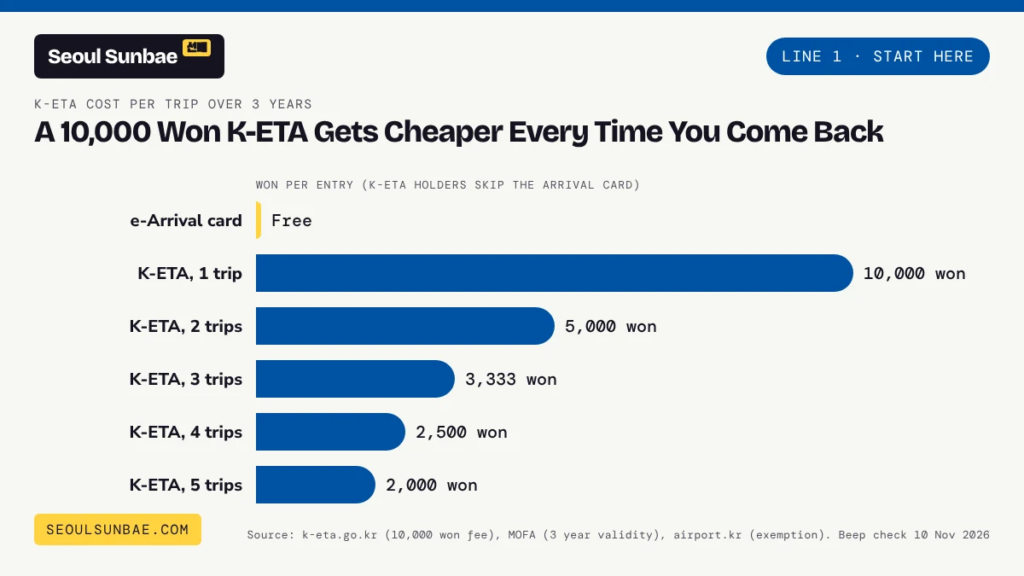
| Same passport, chose to get a K-ETA anyway | Optional, 10,000 won, valid 3 years | No | Nothing to fill in at the airport |
| Other visa waiver nationality that needs K-ETA | Yes, 10,000 won | No, once approved | Apply at least 72 hours before you fly |
| Visa waiver traveller aged 17 and under or 65 and over | No (age exemption since 3 Jul 2023) | Yes, unless they hold a K-ETA | e-Arrival card for each person |
| Arriving on a visa (study, work, family) before registering | Not applicable | Yes | e-Arrival card, then register once settled |
| Registered foreign resident with a residence card | No | No | Show passport and residence card |
| Airline or ship crew on duty | No | No | Crew channel |
Sources: Incheon Airport arrival procedure, K-ETA official application page (fee and 72 hour review), Korean Consulate General in Chicago notice (age exemption and three year validity).
How To Fill In The e-Arrival Card Online
The e-Arrival card lives at www.e-arrivalcard.go.kr, works on a phone or a laptop, and is free. The Ministry of Justice launched it on 24 February 2025, and the site runs in Korean, English, Chinese, Japanese, Thai, Vietnamese and Russian, according to the Korea Herald’s report on the launch. Anything else asking for money for an “arrival card” is a third party reselling a free form.
- Wait until you are inside the window. The Ministry of Justice Q&A says you can submit from three days before arrival, and the card is valid for 72 hours from submission.
- Have your passport open. You type in passport details, your flight in and out, purpose of visit, where you are staying, contact details and occupation.
- Give a real address for your first night. A hotel name plus its street address is what the officer wants to see; “Seoul” alone is not an address.
- Submit and keep the confirmation email, which carries your card number and expiry. You can download a PDF or screenshot it, but the Ministry says you do not have to show either at the immigration desk.
- Made a typo? You can edit the card right up to your entry inspection using the issuance number or email verification.
Two rules catch people out. The card is single use, so a new trip means a new card. And if your flight is delayed so you land more than 72 hours after you submitted, the card has expired and you submit again. If you forgot entirely, the Ministry says you can still complete an e-Arrival card or a paper card after landing, before you reach the desk.
What Happens On Arrival At Incheon
Incheon’s own guide breaks entry into three steps. First, the arrival card (already done if you went electronic). Second, queue in the right lane: Korean nationals in the blue lane, foreign nationals in the red lane. Third, the inspection, where you hand over your passport, and your arrival card if you used paper. Foreign nationals aged 17 and over give fingerprints and a facial scan at the desk, so take off your hat and glasses before you get there.
After immigration it is baggage, then customs, then the train. My full walkthrough of the train, bus and taxi options is in the Incheon Airport To Seoul guide, and you will want data working before you leave the terminal, which the SIM or eSIM guide covers.
e-Arrival Card Vs Paper Card Vs K-ETA
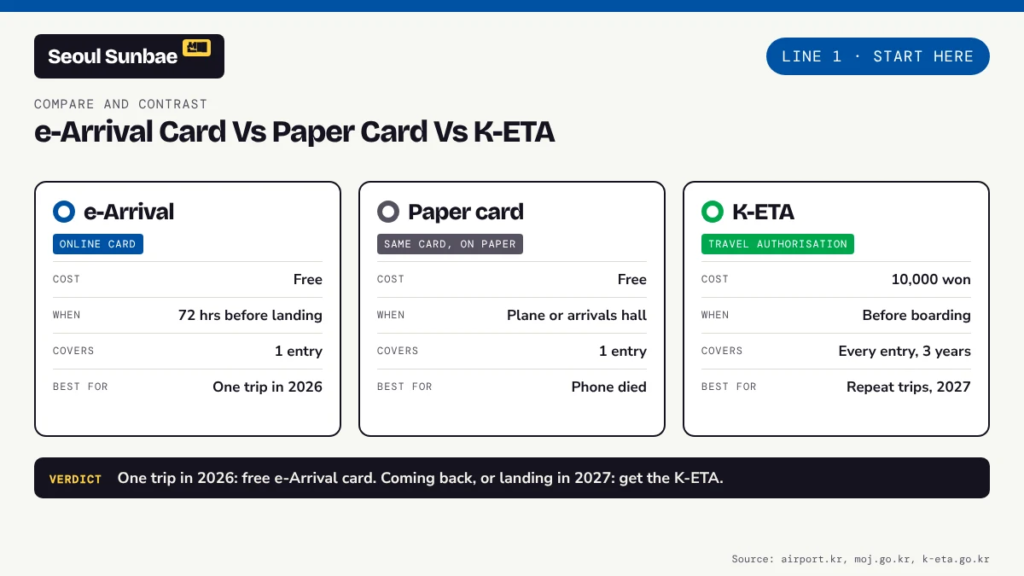
These three get muddled constantly, so here is the contrast in plain terms. The e-Arrival card and the paper card are the same document in two formats: a one trip declaration of who you are, why you are here and where you are sleeping. The K-ETA is something else entirely. It is a pre travel authorisation you apply for before boarding, it costs 10,000 won, it is valid for three years, and while it is valid it replaces the arrival card on every entry.
| Feature | e-Arrival card | Paper card | K-ETA |
|---|---|---|---|
| Cost | Free | Free | 10,000 won |
| When | From 72 hours before landing up to the desk | On the plane or in the hall | Before boarding; review can take up to 72 hours |
| Covers | One entry | One entry | Every entry for 3 years (within passport validity) |
| Arrival card still needed? | This is the card | This is the card | No |
| Best for | One trip on an exempt passport in 2026 | Fallback if your phone dies | Repeat visitors, and most people from 2027 |
On paper cards, there is genuine confusion online. Incheon Airport describes the e-Arrival card as generally mandatory for foreign nationals, while reporting in March 2026 from VisasNews and iVisa quoted the Ministry of Justice’s e-Arrival Card Service saying both formats stay in use until a complete abolition of paper is officially announced. No such announcement had appeared by this beep check. In practice that means paper works, but you are the person filling in a form on your knee while the e-Arrival people walk past you.
The verdict. If this is your one trip to Korea in 2026 and your passport is on the exempt list, do the free e-Arrival card and do not pay for anything. If you expect to come back within three years, or you are arriving on or after 1 January 2027 when the temporary exemption is scheduled to end, pay the 10,000 won for a K-ETA through the official site and never think about arrival cards again. What changes next year is in my K-ETA 2027 guide, and the screen by screen form walkthrough is in the e-Arrival card guide.
Common Mistakes That Slow You Down
Submitting too early is the classic one. People do it at home a week before the flight to “get it out of the way”, and the card is dead before they land, because validity is 72 hours from submission. Do it the night before you fly or in the departure lounge.
Paying an agent is the expensive one. The e-Arrival card is free, and the official K-ETA page warns that unofficial agencies charge high fees for “expedited” applications. Use e-arrivalcard.go.kr and k-eta.go.kr (or the official K-ETA app) and nothing else.
Reusing last trip’s card is the quiet one. Each card covers a single entry, so day trippers to Japan and back need a fresh card for the return into Korea unless they hold a K-ETA.
Forgetting the kids is the family one. A child under 17 on a visa waiver passport is exempt from K-ETA, which also means they have no K-ETA to excuse them from the card. Fill in one for each traveller who does not hold their own approval.
Leaving the address vague is the slow one. A hotel name with its street address gets you through; a blank or a city name invites questions at the desk.
Finally, if you are applying for a K-ETA this week, the official site posted a notice of a scheduled service suspension on 11 November 2026, so check the notice board there before you count on a same day approval. The bigger picture of what to sort before you fly is on the Start Here page.
Frequently Asked Questions
Is The Korea e-Arrival Card Free?
Yes. The official site, www.e-arrivalcard.go.kr, charges nothing. Any website that asks for a fee to submit your arrival card is a third party service, and you do not need it.
How Early Can I Submit The Korea Arrival Card?
From three days (72 hours) before you arrive, according to the Ministry of Justice. The card is valid for 72 hours from submission, so if your flight slips past that, submit a new one.
Do I Need An Arrival Card If I Have A K-ETA?
No. Incheon Airport lists valid K-ETA holders among the groups exempt from the arrival card, and the Korean government has pointed out that travellers on the exempt list can apply for a K-ETA voluntarily if they want that benefit.
Is The Paper Arrival Card Still Accepted In 2026?
Reporting in March 2026 quoted the Ministry of Justice saying paper and electronic cards remain in parallel use until paper is officially abolished, and no abolition had been announced at this beep check. The electronic card is faster and is what the airport pushes, so use it if you can.
Do Children Need Their Own Arrival Card?
Each traveller who does not hold a K-ETA or a Korean residence card needs a card. Visa waiver travellers aged 17 and under are exempt from K-ETA, so in practice most children fill in their own arrival card.