TL;DR
Korean winter runs from early December to late February. Seoul averages 0.2°C in December, −1.9°C in January and 0.7°C in February, with nights around −3 to −6°C. Inland Gangwon is far colder (Daegwallyeong averages −7.0°C in January), while Busan and Jeju stay above freezing. Snow is most reliable in the Gangwon mountains and least likely in Busan.
Last checked: 14 Oct 2026 What is a Beep Check?
Sunbae Says: Pack for the wind, not the thermometer. A −5°C morning in Seoul with a northwesterly feels much colder than the number on your weather app, and the cold is drier and sharper than most visitors expect.
You step out of your hotel at 8am in January. The app says −6°C, the wind is coming straight down the street, and you suddenly understand why everyone on the subway is wearing a knee length padded coat. This guide tells you where in Korea that happens, and where it does not.
The Table: Winter By Region
These are the official 1991 to 2020 climate normals (평년값) from the Korea Meteorological Administration (KMA), station by station. Format: monthly mean, then average daily high and low, in °C. “Snow days” are days when snow was observed falling, not days with snow on the ground.
| Station (Region) | December | January | February | Snow Days Dec / Jan / Feb |
|---|---|---|---|---|
| Seoul (capital) | 0.2 (4.2 / −3.4) | −1.9 (2.1 / −5.5) | 0.7 (5.1 / −3.2) | 6.4 / 7.1 / 5.1 |
| Chuncheon (Yeongseo, inland Gangwon) | −2.0 (3.5 / −6.6) | −4.1 (1.9 / −9.3) | −1.0 (5.4 / −6.7) | 6.7 / 8.8 / 6.3 * |
| Cheorwon (northern Gangwon) | −3.2 (2.7 / −8.6) | −5.7 (0.7 / −11.8) | −2.3 (4.1 / −8.6) | 7.3 / 9.2 / 6.2 * |
| Daegwallyeong (Pyeongchang, ski country) | −4.5 (0.5 / −9.4) | −7.0 (−1.8 / −12.2) | −4.6 (0.6 / −10.1) | 10.9 / 13.0 / 11.8 * |
| Taebaek (high Gangwon) | −2.3 (3.0 / −7.1) | −4.7 (0.7 / −9.6) | −2.5 (3.1 / −7.8) | 7.6 / 10.7 / 9.7 * |
| Gangneung (Yeongdong, east coast) | 3.3 (7.7 / −0.5) | 0.9 (5.3 / −2.7) | 2.7 (7.1 / −1.3) | 2.9 / 6.0 / 6.0 * |
| Jeonju (Jeolla) | 2.2 (7.1 / −2.1) | 0.0 (4.8 / −4.3) | 2.0 (7.5 / −2.8) | 7.2 / 8.3 / 5.0 |
| Gwangju (Jeolla, near the west coast snow belt) | 3.2 (8.0 / −0.8) | 1.0 (5.7 / −2.7) | 2.9 (8.3 / −1.5) | 8.4 / 9.9 / 6.3 |
| Daegu (southeast) | 3.0 (7.9 / −1.2) | 1.1 (5.9 / −2.9) | 3.5 (8.8 / −1.1) | 3.0 / 4.2 / 2.2 |
| Busan (south coast) | 5.8 (10.4 / 2.0) | 3.6 (8.2 / −0.1) | 5.4 (10.2 / 1.5) | 0.9 / 1.4 / 1.2 |
| Jeju City (north coast of Jeju) | 8.3 (11.0 / 5.6) | 6.1 (8.6 / 3.7) | 6.8 (9.9 / 4.0) | 5.3 / 7.2 / 4.2 |
* Snow days marked with an asterisk are KMA’s 1981 to 2010 normals, the latest published for that station in the table I used. Seoul’s monthly means are from KMA’s own release on the new normals (in Korean); the other stations come from KMA’s normals as reproduced in each station’s climate table. Treat everything as approximate to a few tenths of a degree.
That same KMA release says Korea’s winter is now 87 days long, starting around 4 December and ending around 28 February, a week shorter than under the old normals.
Why The Regions Differ So Much
Yeongseo vs Yeongdong. Gangwon is split by the Taebaek mountain range. West of it (Yeongseo: Chuncheon, Hongcheon, Cheorwon, Pyeongchang) the cold continental air pools in valleys, which is why Cheorwon’s January nights average −11.8°C. East of it (Yeongdong: Gangneung, Sokcho) the sea keeps things milder, so Gangneung’s January mean is almost 5°C warmer than Chuncheon’s, at roughly the same latitude.
East coast snow comes late and comes big. Yeongdong snow often arrives in February and March, when northeasterly winds push moisture off the East Sea into the mountains. In February 2011 Gangneung recorded 77.7 cm of new snow in a single day, Kyunghyang Shinmun reported (in Korean), and seven of the nine Gangwon snowfalls of 20 cm or more between 2000 and 2011 fell in February or March. If you want deep snow on the coast, late winter is your window.
The west coast snow belt. When cold air crosses the relatively warm Yellow Sea, the temperature gap between sea and air (해기차) builds bands of snow cloud that dump on the Jeolla and Chungnam west coast and Jeju’s mountains. In December 2022 KMA forecast 20 cm or more (in Korean) for parts of the Honam west coast and 50 cm or more on Jeju’s mountain while Seoul expected under 1 cm. That is why Gwangju logs more snow days than Seoul despite being warmer.
Busan and the southeast stay dry and sunny. Busan averages barely one snow day a month in winter. Expect cold, bright, windy days rather than snow.
Jeju is two climates. Jeju City by the sea rarely freezes, but Hallasan, South Korea’s highest mountain, gets proper alpine winter, with winter trail cut off times on its trails. My Jeju in November guide covers the island’s shoulder season, and where to see snow in Korea covers Hallasan in winter.
Seoul’s First Snow
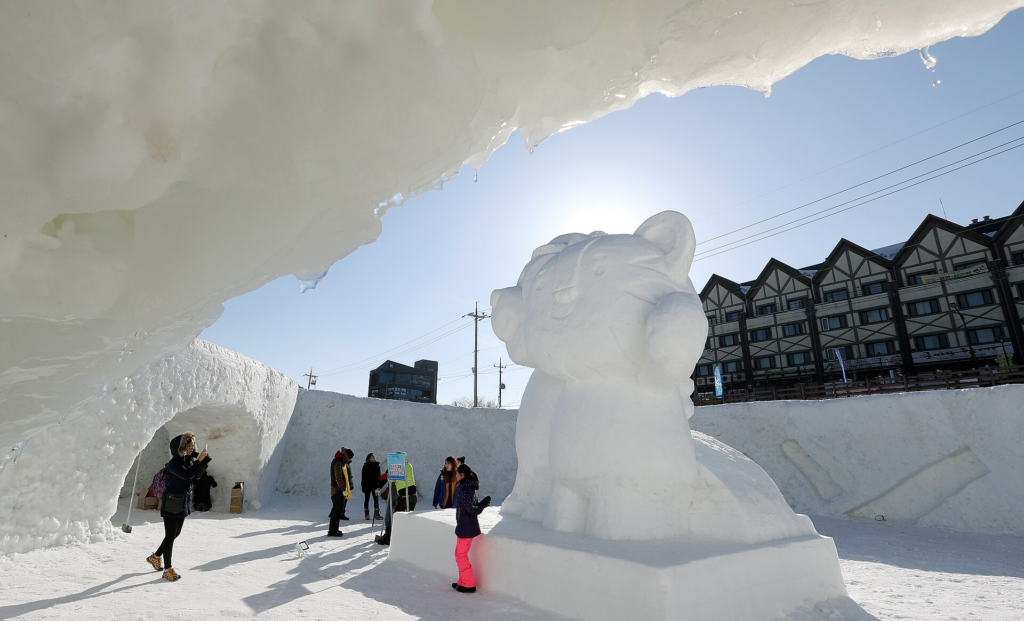
Seoul’s normal first snow date is around 20 November, measured by an observer at the Seoul Weather Observatory in Songwol-dong, Jongno-gu, who has to see it fall. Recent winters:
| Winter | Seoul’s First Snow | Note |
|---|---|---|
| 2023/24 | 17 November 2023 | 3 days earlier than normal |
| 2024/25 | 26 November 2024 | Followed by 18.0 cm on 27 November, the most for any November day since records began in 1907 |
| 2025/26 | 4 December 2025 | Heavy bursts of 5 cm an hour; 19 roads closed that evening |
Sources: Segye Ilbo on 2024 (in Korean) and on 2023, Kyunghyang Shinmun on the November 2024 record (in Korean), and the December 2025 report (in Korean). The lesson: a first snow can be a dusting or a disaster, and it can come any time from mid November to early December.
Heads Up: A heavy first snow can gridlock Seoul. On 4 December 2025, 19 roads closed and traffic in the city centre crawled at 5.9 km/h; on a snow day, take the subway, not a taxi or airport bus with a tight connection.
Cold Waves, Wind Chill And Black Ice
KMA issues a cold wave advisory (한파주의보) when the morning low is expected to stay at −12°C or below for two days or more, and a cold wave warning (한파경보) at −15°C or below, according to the Hanam city government’s summary of the criteria (in Korean). Under the 1991 to 2020 normals, Seoul gets about 3.1 days a year with a morning low of −12°C or below.
Last winter shows how it plays out. KMA’s 2025/26 winter summary (in Korean) found the season 0.6°C warmer than normal overall, with December 1.3°C warmer and February 1.5°C warmer, but January 0.7°C colder thanks to an Arctic cold spell lasting more than ten days. It was also very dry nationally: 53 percent of normal precipitation and 14.7 cm of snow against a normal 26.4 cm.
Heads Up: Black ice is the real winter danger in Korea, on pavements, bridges and mountain roads. After a melt and refreeze, walk on the gritted strip, hold the handrail on subway steps, and think twice before a self drive trip into Gangwon on a cold wave morning.
Wind chill makes the difference. A northwesterly on an open bridge or a ski slope can make −5°C feel like −15°C. Korean weather apps show 체감온도 (feels like) next to the real temperature: dress for that number.
Fine Dust And Yellow Dust
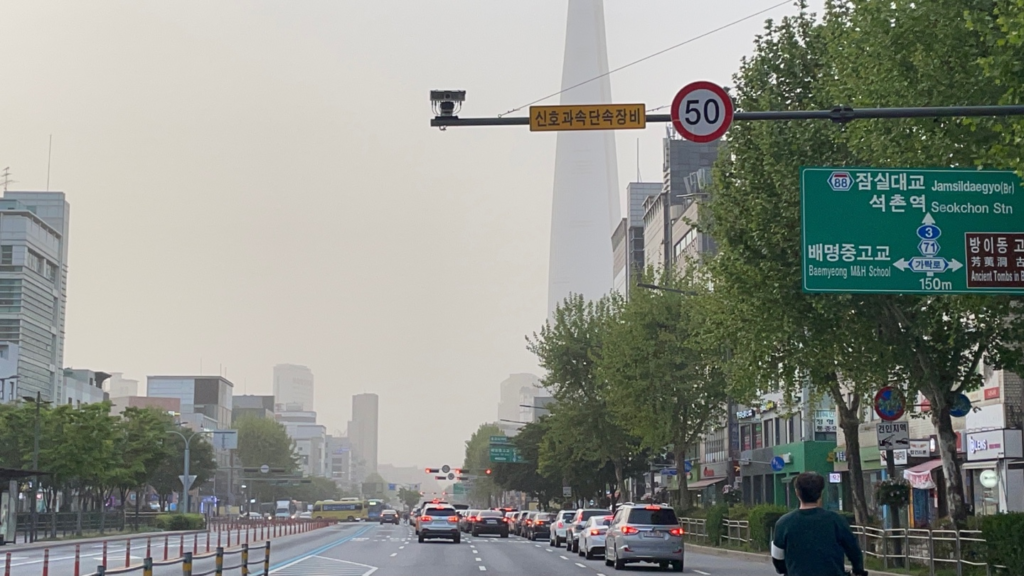
Winter is fine dust season, not just cold season. Korea runs a seasonal fine dust management period (in Korean) from December to March because concentrations typically rise in those months; the seventh round ran December 2025 to March 2026, with the most polluting old vehicles restricted in the capital region and coal plants throttled back.
Yellow dust (황사), sand blown in from deserts to the west, is mainly a March and April problem, but it can hit in winter: in February 2015 Seoul’s PM10 reading hit 1,044 µg/m³ in the worst winter yellow dust in five years (in Korean). If you are sensitive, check the AirKorea app each morning and carry a KF94 mask.
This Winter’s Outlook
KMA’s three month outlook issued on 23 September 2026 (in Korean) gives a 50 percent chance that December 2026 will be warmer than normal (normal range 0.5 to 1.7°C nationally), 40 percent similar and 10 percent colder. My read: expect a mild start with sharp cold snaps, which is exactly when black ice forms. Outlooks for January and February come later; I post updates on what’s on.
What It Means For Your Packing
For Seoul in December to February you want a long padded coat, a warm hat, gloves you can use a phone in, thermal base layers and boots with grip. For Gangwon ski country add a neck gaiter and goggles; the ski resorts near Seoul guide explains what to rent instead of pack. For Busan and Jeju, a warm jacket and layers usually do it. My full list is in what to wear in Korea in autumn and winter.
What Locals Know
Koreans dress for the morning low. After more than 20 winters here, I can tell you the long padded coats come out the week Seoul’s mornings first dip below zero, whatever the afternoon brings.
“Three cold days, four warm days” (삼한사온) is still how people talk about winter. The idea is that cold snaps arrive in bursts and then ease, so a brutal morning is rarely the whole week.
Heated floors are the cure. Korean homes, guesthouses and jjimjilbang floors are heated, and that is where locals thaw out. A hot fish cake from a street food cart helps too.
Snow alerts arrive by text. In December 2025 KMA sent Seoul its first heavy snow emergency text of the season when 5 cm fell in an hour. Your phone will buzz in Korean; a translation app makes sense of it, and my travel apps guide sets one up.
Pick Your Version
If It’s Your First Time
I’d base yourself in Seoul and make one snow trip to Gangwon. Seoul has real winter without the extremes, and a day in Pyeongchang shows you the deep cold. Korea in December has the month’s events.
If You’re Bringing Kids
Plan indoor mornings and outdoor afternoons, when it is a few degrees warmer. My Seoul with kids in winter guide is built around that rhythm.
If You’re Travelling Solo
February is when the east coast snow tends to arrive. I’d pair Gangneung with a festival from my winter ice festivals guide.
If You’re Here For A Reset
Cold dry air, heated floors and hot baths are the Korean winter wellness routine. If fine dust bothers you, keep an eye on the morning reading and plan indoor days when it spikes.
Sunbae’s Picks
My pick for snow you can count on: Daegwallyeong, with more than ten snow days a month on the old normals and the ski season to match. The ski season calendar shows when the resorts open.
If I wanted mild winter sightseeing, I’d go to Busan: January means of 3.6°C and almost no snow.
I’d skip planning around a white Christmas in Seoul. It happens, but the first snow is often a dusting and last December was warmer than normal.
My late winter move: Gangneung in February for coastal snow, a warm café and the sea.
Word Of The Stop
한파 (hanpa), “cold wave”. You will hear it on the news and see 한파주의보 (cold wave advisory) in alerts. When it appears, layer up and allow extra time on icy pavements.
Map And Directions
- 1Seoul Weather Observatory (Songwol-dong) 서울기상관측소
Where Seoul's first snow is officially observed by eye; normal first snow about 20 Nov; January mean −1.9°C (1991 to 2020)
- 2Daegwallyeong weather station 대관령 기상관측소Area pin
Korea's classic cold and snow station; January mean −7.0°C, mean low −12.2°C (1991 to 2020)
- 3Chuncheon weather station 춘천 기상관측소Area pin
Inland Yeongseo cold: January mean −4.1°C, mean low −9.3°C
- 4Gangneung weather station 강릉 기상관측소Area pin
Milder east coast (January mean 0.9°C) but big February and March snowfalls
- 5Busan weather station 부산 기상관측소Area pin
January mean 3.6°C, about one snow day a month in winter
- 6Jeju weather station (Jeju City) 제주 기상관측소Area pin
January mean 6.1°C at sea level; Hallasan above has deep snow and winter trail cut off times
Your Tickets
Tap a button to open directions on your phone. In Korea, Naver Map and KakaoMap give full walking directions; Google Maps covers subway and bus but, as of September 2026, still has no turn by turn walking or driving here. Pins marked “Area pin” show a neighbourhood, not a door.
Frequently Asked Questions
What Is The Coldest Month In Korea?
January. Seoul’s 1991 to 2020 January mean is −1.9°C, and inland Gangwon is colder: Daegwallyeong averages −7.0°C, with mean lows of −12.2°C.
Does It Snow In Seoul?
Yes, on about six or seven days a month in December and January on the 1991 to 2020 normals, but it often melts within a day. The first snow usually comes around 20 November.
Does It Snow In Busan?
Rarely: about one snow day a month in winter. Expect cold, dry, sunny days.
Is Jeju Warm In Winter?
Milder, not warm. Jeju City averages 6.1°C in January, but Hallasan has deep snow and winter trail rules.
When Is Fine Dust Worst In Korea?
Fine dust tends to rise from December to March, which is why Korea runs a seasonal management period then; yellow dust peaks in March and April.
Next Stop
- What To Wear In Korea In Autumn And Winter: turn these numbers into a packing list.
- Where To See Snow In Korea: the best snow scenery trips from Seoul.
- Korea’s Winter Ice Festivals: what to do with all that cold.
Resources
- KMA English site: forecasts, warnings and cold wave alerts.
- Naver Weather or another Korean weather app: hourly forecasts with 체감온도 (feels like).
- AirKorea: live fine dust readings in English.
- 1330 Korea Travel Hotline: dial 1330 (or +82-2-1330 from abroad) for English help, 24 hours.
How I Checked This
On 14 October 2026 I took monthly temperature and snow day normals from KMA’s 1991 to 2020 climate normals, using KMA’s own release for Seoul and KMA sourced station climate tables for the rest, because the KMA data portal would not load from my connection. I checked first snow dates against Segye Ilbo and Kyunghyang reports of KMA observations, cold wave criteria against a city government page, and last winter and this winter against KMA’s own summary and outlook. Still approximate: snow days for some Gangwon stations are 1981 to 2010 figures, and January and February 2027 outlooks were not yet issued.
Sources
- KMA: new 1991 to 2020 climate normals, Seoul monthly means, winter length (Korean)
- KMA, Climatological Normals of Korea (1991 to 2020), station values for Chuncheon, Cheorwon, Daegwallyeong, Taebaek, Gangneung, Jeonju, Gwangju, Daegu, Busan and Jeju City, as reproduced in the Wikipedia climate tables for Seoul, Daegwallyeong, Chuncheon, Cheorwon, Taebaek, Gangneung, Jeonju, Gwangju, Daegu, Busan and Jeju City
- KMA: winter 2025/26 climate summary (Korean)
- KMA: three month outlook issued 23 Sep 2026 (Korean)
- Segye Ilbo: Seoul first snow 26 Nov 2024, normal 20 Nov (Korean)
- Segye Ilbo: Seoul first snow 17 Nov 2023 (Korean)
- Kyunghyang Shinmun: 18.0 cm November record, 27 Nov 2024 (Korean)
- Daum (news report): first snow and road closures, 4 Dec 2025 (Korean)
- Hanam City: cold wave advisory and warning criteria (Korean)
- Kyunghyang Shinmun: Gangneung 77.7 cm, Feb 2011, and why Yeongdong snow peaks in Feb and Mar (Korean)
- Newsis: west coast sea effect snow, Dec 2022 (Korean)
- Segye Ilbo: seventh seasonal fine dust management, Dec 2025 to Mar 2026 (Korean)
- Seoul Shinmun: winter yellow dust, Feb 2015 (Korean)
- Weekly Kyunghyang: first snow six days later than normal, Dec 2024 (Korean)
Written by your sunbae. Over 20 years in Korea. We learned the lessons the hard way, so you don’t have to, and we’re here to guide you and help you enjoy Korea. Every fact here is checked against official sources and, wherever possible, on the ground.
Beep Check: verified 14 Oct 2026. Rules, prices and dates change; confirm with the official source before you travel.