Tag: Solo

  • Jjimjilbang For First Timers: The Korean Spa Rules Nobody Explains

    Jjimjilbang For First Timers: The Korean Spa Rules Nobody Explains

    TL;DR

    A jjimjilbang is a Korean bathhouse plus sauna complex, often open 24 hours, where you pay one entry fee (about 14,000 to 16,000 won at a central Seoul spot in 2026), strip off in a single sex bath area, then change into a provided uniform for the shared sauna rooms. Shower first, stay naked in the baths, stay clothed everywhere else. That’s the whole deal.
    Route map of the stops in this Seoul Sunbae guide: Jjimjilbang For First Timers: The Korean Spa Rules Nobody Explains

    Last checked: 5 Oct 2026 What is a Beep Check?

    Picture it: you’ve walked palaces and markets all day, it’s cold outside, and your calves are done. An hour later you’re on a heated floor with a baked egg in one hand and an icy rice drink in the other.

    Sunbae Says: Arrive before 8pm. At SPAREX (blue) Dongdaemun the day rate is 14,000 won and the night rate, from 8pm, is 16,000 won, and it’s the time you walk in that counts. Then strap the locker key band to your wrist: it’s your wallet for snacks, drinks and the scrub.

    How A Jjimjilbang Actually Works

    There are two halves, and first timers mix them up.

    The bath floor (목욕탕, mogyoktang) is split by sex. Here you are fully naked: hot tubs, cold plunge, steam room, dry sauna, standing showers and rows of low sitting showers. Nobody is looking at you. Everyone is too busy scrubbing.

    The jjimjil floor is shared. You wear the matching T shirt and shorts handed over at the counter. Families nap on heated floors, couples watch TV, friends eat baked eggs outside the kiln rooms.

    Your first visit goes like this:

    1. Take your shoes off at the entrance and lock them in the shoe locker.
    2. Pay at the desk for a towel, uniform and locker key.
    3. Undress fully in your side’s changing room and shower thoroughly.
    4. Soak, sweat, repeat.
    5. Dry off, put on the uniform, head to the shared floor.
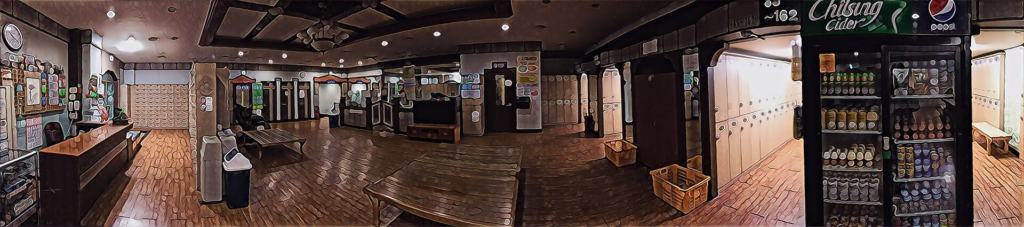
    찜질방 전경
    찜질방 전경, 2020. Photo: Choikwangmo9, CC0, via Wikimedia Commons.

    The Unwritten Rules

    After 24 Seoul winters, these are the ones I watch visitors break. My wider unwritten rules of Korea guide covers the rest of daily life.

    Shower before the tubs, every time. Soap, rinse, then soak. Walking straight from the locker into the hot pool is the fastest way to earn a look from an ajumma.

    Nothing goes in the water. No towels, no long hair down, no swimsuit. The small towel sits on your head or on the side. Water park style spas differ on swimwear, so check at the counter.

    No phones on the bath floor. Cameras are banned in the changing rooms and baths. Leave the phone in your locker; Koreans call the result a forced digital detox.

    Quiet on the sleeping floor. At night people really do sleep there. Calls go in the lobby.

    Tattoos are mostly fine. Korea is more relaxed than Japan here. Casual tattoos are generally allowed, but Korean listings for SPAREX (blue) Dongdaemun note that large tattoos can be refused, so if yours is big, ask before you pay.

    Kids follow their own rule. Since 22 Jun 2022, children aged 4 and over (48 months) may not enter the opposite sex bath or changing room, under the amended public hygiene rules reported by KBS (in Korean). SPAREX goes further and bars boys over 105 cm from the women’s side. Dad takes the boys, Mum takes the girls.

    Under 19 at night needs a guardian. SPAREX requires minors to be with a guardian from 10pm to 5am.

    Pick Your Spa: What It Costs In 2026

    Prices change with the hour you arrive. These were checked on 5 Oct 2026 against operator and ticket listings; confirm at the counter.

    Spa Best For Price (Adult) Hours Getting There My Take
    SPAREX (blue) Dongdaemun (Goodmorning City, B3) First timers, late nights after shopping 14,000 won day, 16,000 won from 8pm 24 hours Dongdaemun History & Culture Park Station (Line 2 green, Line 4 sky blue, Line 5 purple), Exit 14 My pick. Central, hanok themed, rules in English
    SPAREX Dongmyo (13F) A quieter, newer feel 14,000 won day, 16,000 won night 24 hours Dongmyo Station (Line 1 dark blue, Line 6 brown), Exit 6, about 40 m Bring real ID if you plan to stay the night
    Aquafield Goyang (Starfield, 4F) Families, a spa day with mountain views 26,000 won for 6 hours 10am to 10pm Samsong Station (Line 3 orange), Exit 3, about 8 min walk Worth the trip on a grey day; 5,000 won per extra hour

    Admission normally includes the towel and uniform. SPAREX tells you to bring your own shampoo and conditioner or buy single use packs; Aquafield puts toiletries out. Most “24 hour” places still cap your stay and charge for overtime, and Aquafield’s own page (in Korean) lists its 6 hour limit and 5,000 won per extra hour.

    Korean listings put SPAREX Dongdaemun at Exit 13 and SPAREX’s own ticket page says Exit 14; the two exits sit side by side opposite DDP, and the Goodmorning City Gate 1 lift takes you to B3.

    The body scrub (세신, sesin) is extra. SPAREX’s ticket listing puts its basic men’s scrub at 25,000 won on site, and Korean listings say the counter often wants cash. A scrubber in black underwear (women’s side) or shorts (men’s side) works you over with an Italy towel until grey rolls of dead skin appear. It’s brutal. It’s glorious.

    Heads Up: Lose your locker key at SPAREX and you pay 20,000 won. Keep the band on your wrist in the tub, in the sauna and on the sleeping floor.

    Offers Worth Knowing

    At SPAREX, children pay 7,000 won by day and 8,000 won at night, and children under 24 months enter free. Aquafield lets children under 36 months in free with proof of age. Getting there, Seoul’s short term tourist passes of 1, 2, 3, 5 and 7 days (in Korean) still run even though the 30 day Climate Card has ended; my transit card guide explains which fits.

    Worth It / Skip It

    Worth It: A classic 24 hour jjimjilbang like SPAREX (blue) on a cold November evening. Warm, cheap and very Korean.

    Skip It: Sleeping overnight as a hotel substitute unless you’re stranded after the last train. Thin mat, snoring neighbours, bright lights, and at some places the baths shut for cleaning in the small hours. A great story once, a bad plan for a week.

    Heads Up: Plenty of English guides still send you to Dragon Hill Spa by Yongsan Station, Itaewon Land or Siloam Sauna near Seoul Station. All three are gone. Dragon Hill paused during COVID in 2021 and never reopened, Itaewon Land’s building was demolished, and Siloam’s address is now a car park, according to an August 2026 check by Korean spa listing site Luwei. Even an older Korean language Visit Seoul feature still lists Dragon Hill. Check the date on anything you read.

    What Locals Know

    The neighbourhood bathhouse is disappearing. Korea had 9,950 bathhouses, saunas and jjimjilbangs in 2000 and 5,668 last year, Seoul Shinmun reports (in Korean), squeezed by gas bills that rose about 53% since 2020. Average bath prices went from roughly 5,400 to 7,200 won in 2020 to 7,750 to 11,000 won this February. What survives is the big, well run spa, which is good news for you.

    Young Koreans are bringing it back. Searches for “sauna” by people in their 20s and 30s jumped 31% year on year in March, and spending at private sesin scrub shops through Creatrip, a booking platform for foreign visitors, rose 462% in the first half, Korea JoongAng Daily reports. Expect younger crowds on weekend nights.

    Small places keep odd hours. Neighbourhood bathhouses often close one weekday a month, change the water early in the evening, and post notices only on the door. If you’re going local, check the Naver Map listing on the day.

    Write your name on the board first. On the bath floor, the scrub board fills fast after dinner. Sign up the moment you arrive, then soak while you wait: soft skin is the point of the soak.

    Pick Your Version

    If It’s Your First Time. I’d go to SPAREX (blue) Dongdaemun on a weekday, arrive around 6pm to lock in the day rate, and give it two to three hours. The Dongdaemun night markets are next door when you’re done. Don’t sleep over on your first visit. Pair it with a cold night from my November guide and you’ll get why Koreans treat this as winter medicine.

    If You’re Bringing Kids. Plan the split before you arrive: from age 4 your child uses the bath of their own sex, so one adult goes with each. Leave before 10pm if anyone is under 19. Aquafield is the easiest family day. My Seoul with kids guide has more cold day backups.

    If You’re Travelling Solo. A jjimjilbang is one of the easiest solo evenings in Seoul, because everyone is there to switch off. Women who want a women only space can search 여성전용 사우나 on Naver Map; my Korea travel apps guide shows how. More ideas in my solo Seoul guide.

    If You’re Here For A Reset. Make it a ritual: soak, scrub, rest on the heated floor, home early. Pair one evening here with a night at a temple from my templestay guide, and browse the rest of The Reset for slower ways to do Seoul.

    Sunbae’s Picks

    My pick for a first go: SPAREX (blue) Dongdaemun, before 8pm, on a weekday. Central, open 24 hours, and its rules are published in English.

    If I only had one evening, I’d sign the scrub board, soak, get scrubbed, then eggs and sikhye upstairs and home by 10pm.

    I’d pack my own shampoo and moisturiser, because many places don’t supply them and the dry heat is real in late autumn. My what to wear guide covers layers for the walk home, when you feel the cold on warm skin.

    The Trend Behind This

    Bathing is being rebranded as wellness. When the city announced the Seoul Wellness 100 on 1 Sep 2026, beauty and spa sat in its 31 place Style group, and Seoul Wellness Travel Week from 29 Oct puts more attention on it. My read: more English menus at the big spas, while the old neighbourhood places stay as they are, which is their charm.

    Eat And Drink Like A Regular

    Two things are essential on the jjimjil floor. Maekbanseok gyeran are eggs baked in the kiln until the whites go brown and chewy. Sikhye (식혜) is a sweet, icy rice drink. Order both at the snack bar, charge them to your key band, settle up when you leave. SPAREX (blue) bans outside food and alcohol. Still hungry? My winter street food guide covers what’s outside.

    What To Bring

    • Hair tie and a comb
    • Shampoo, conditioner and face wash (often not supplied)
    • Moisturiser and a small bag for wet things
    • Cash for the scrub, and real ID if you might stay overnight

    A Quick Health Note

    This is general information, not medical advice. The hottest kiln rooms are seriously hot, so drink water, keep sessions short, and skip the sauna after alcohol. If you’re pregnant or have a heart or blood pressure condition, ask your own doctor first. If you get unwell while travelling, the government run Medical Korea Support Center answers on 1577-7129 (+82-2-1577-7129 from abroad), and Medical Korea lists registered hospitals and lets you verify registered medical facilitators. We never take commissions from clinics or hospitals.

    Word Of The Stop

    세신 (sesin): body scrub. Say “sesin hal su isseoyo?” (“can I get a scrub?”) at the counter. The scrub board with names and times is usually on the bath floor.


    Map And Directions

    1. 1
      SPAREX Dongdaemun (Goodmorning City B3) 스파렉스 동대문 굿모닝시티점
      Dongdaemun History & Culture Park StationEXIT14 (Korean listings say EXIT13; side by side)

      24 hours; 14,000 won 5am to 8pm, 16,000 won from 8pm; lift from Goodmorning City Gate 1 to B3; lost key 20,000 won

    2. 2
      SPAREX Dongmyo (13F) 스파렉스 동묘점Area pin
      Dongmyo StationEXIT6

      24 hours; 14,000 won day, 16,000 won night; about 40 m from the exit; bring real ID to stay overnight

    3. 3
      Aquafield Goyang (Starfield Goyang 4F) 아쿠아필드 고양
      Samsong StationEXIT3

      Jjimjil spa 10am to 10pm; 26,000 won adult for 6 hours, 5,000 won per extra hour; about 8 min walk

    Last Mile

    • Myeong-dong Station → Dongdaemun History & Culture Park Station about 5 min
    • Dongdaemun History & Culture Park Station EXIT14 → SPAREX Dongdaemun 1 to 2 min
    • Dongdaemun History & Culture Park Station → Dongmyo Station check Naver Map
    • Gyeongbokgung Station → Samsong Station check Naver Map
    Get the map appsNNaver Map App Store Google PlayKKakaoMap App Store Google PlayBoth work in English. With the app installed, the Naver Map and KakaoMap buttons open directions straight to the pin.

    Tap a button to open directions on your phone. In Korea, Naver Map and KakaoMap give full walking directions; Google Maps covers subway and bus but, as of September 2026, still has no turn by turn walking or driving here. Pins marked “Area pin” show a neighbourhood, not a door.

    Frequently Asked Questions

    Do You Have To Be Naked In A Jjimjilbang?

    Only in the single sex bath area. The shared sauna floor is clothed. If nudity is a deal breaker, use only the jjimjil floor, or pick a water park style spa and check its swimwear rules.

    How Much Is A Jjimjilbang In Seoul?

    About 14,000 won by day and 16,000 won at night at central spots like SPAREX (blue) in 2026. Spa parks such as Aquafield cost around 26,000 won for six hours. Scrubs are extra.

    Can You Sleep In A Jjimjilbang?

    Yes, 24 hour places let you sleep on the heated floors, usually within a time limit, and some ask for ID. Minors need a guardian from 10pm to 5am. Fine for one night; it’s not a hotel.

    Is Dragon Hill Spa Still Open?

    No. It paused in 2021 during COVID and never reopened, and Itaewon Land and Siloam Sauna are closed too. Go to a spa that is listed as open on Naver Map today.

    Next Stop

    Resources

    • SPAREX (blue) ticket listing: prices, hours and house rules in English.
    • Aquafield Goyang: hours, prices and time limits (in Korean).
    • NAVER Map: check a spa is listed as open today; search 찜질방 or 여성전용 사우나.
    • 1330 Korea Travel Hotline: English help if there is a problem at the counter.
    • Medical Korea Support Center: 1577-7129, or +82-2-1577-7129 from abroad.

    How I Checked This

    On 5 Oct 2026 I rechecked SPAREX (blue) prices, hours, child rates and house rules against its ticket listing and October 2026 Korean listings, Aquafield against its operator’s page, the child bathing age against KBS, and closures against Korean listing sites, blogs and a Visit Seoul feature. Trend figures come from Seoul Shinmun and Korea JoongAng Daily. The Dongdaemun exit number differs between sources (13 or 14), and the closures rest on listing checks rather than an official notice.

    Sources


    Written by your sunbae. Over 20 years in Korea. We learned the lessons the hard way, so you don’t have to, and we’re here to guide you and help you enjoy Korea. Every fact here is checked against official sources and, wherever possible, on the ground.

    Beep Check: verified 5 Oct 2026. Rules, prices and dates change; confirm with the official source before you travel.

    Seoul Sunbae never takes commissions from clinics or hospitals. This is general information, not medical advice.
  • Ski Resorts Closest To Seoul: Konjiam, Jisan And An After Work Night

    Ski Resorts Closest To Seoul: Konjiam, Jisan And An After Work Night

    TL;DR

    The ski resorts closest to Seoul are Konjiam Resort in Gwangju, Gyeonggi, about 40 minutes by car from Gangnam, and Jisan Forest Resort in Icheon. Both open in December, run evening skiing (Konjiam to 2am), and sell lift time by the hour. Bears Town, Yangji Pine and Starhill, still listed in old guides, no longer offer skiing.

    Last checked: 14 Oct 2026 What is a Beep Check?

    Sunbae Says: If you have one free evening, book a 2 hour ticket online at Konjiam on a Sunday to Thursday after 6pm. It is the closest real ski run to Seoul, and the late discount takes a big slice off the price.

    You finish your museum afternoon in Gangnam at 5pm. By 7pm you could be on a floodlit run with the lights of Gyeonggi below you, and back in bed before midnight. That is what these two resorts are for.

    How It Came To Be

    The ring of small resorts around Seoul is a lot thinner than it was. Korean skier visits peaked at about 6.86 million in the 2011/12 season and fell to about 1.45 million in 2020/21, BizHankook reported (in Korean) in 2022, with operators blaming shorter winters, fewer young skiers and staffing costs. The closest resorts went first. Starhill in Namyangju closed in 2021. Bears Town in Pocheon stopped in 2022, after a lift accident earlier that year. Yangji Pine in Yongin gave up skiing from the 2022/23 season. A January 2026 roundup on Daum (in Korean) confirmed all three as gone. What is left near the city is Konjiam and Jisan, both of which have bet on short, timed sessions for Seoul commuters.

    Heads Up: Some tour sites and older blogs still sell or recommend Bears Town or Yangji Pine for skiing. They are not running ski seasons. Check the resort’s own 2026/27 notice before you pay anyone.

    Season At A Glance

    What Konjiam Resort Jisan Forest Resort
    Opened (last four seasons) 10 Dec 2022*; 8 Dec 2023; 13 Dec 2024*; 10 Dec 2025* 4 Dec 2022†; 6 Dec 2023†; 13 Dec 2024†; 12 Dec 2025†
    Closed (last four seasons) not found; 1 Mar 2024*; 3 Mar 2025*; 8 Mar 2026 (extended) 1 Mar 2023; 3 Mar 2024*; 2 Mar 2025*; 1 Mar 2026
    Typical window Usually opens in the second week of Dec and closes in the first week of Mar; it added a week in March 2026 Usually opens in the first half of Dec and closes on 1 to 3 Mar
    Hours 9am to 2am daily; 7am starts on peak season weekends Day plus weekday night (kiosk tickets from 5pm, gates 6:30pm); late sessions listed to 2am and 4am by VisitKorea
    Slopes and lifts 9 runs, 6.4 km in total, longest 1.6 km; 5 lifts 10 slopes, longest 1,200 m; beginner slope with a moving walkway
    Top elevation 495 m (base 176 m) About 300 m (approx.)
    Average temps, Icheon station Dec about minus 1.2°C; Jan about minus 3.1°C; Feb about minus 0.3°C (KMA 1991 to 2020) Same station
    Snow Little natural snow; both run almost entirely on machine made snow (approx.) Same

    Dates marked * were announced in advance and not confirmed after the day; † only Namuwiki records them. Opening dates come from the resort’s notices and Korean news on the day; closing dates are the soft spot, so check the resort’s notice board in March.

    Sources: Konjiam’s slope page (in Korean) for runs, hours and elevations, Aju Business Daily (in Korean) for the 10 December 2025 opening and early starts, VisitKorea’s roundup for Jisan’s opening and late sessions, K-Trip Tips (in Korean) for Jisan’s slopes, and 여행톡톡 for earlier dates (all in my Sources). Icheon averages come from the KMA normals; in January the low averages about minus 8.5°C. My Korea ski season calendar lines up every other resort.

    Ski slopes at Konjiam Resort near Seoul
    Konjiam Resort, about 40 minutes from Gangnam by car. Photo: 우한길(HK Woo), CC BY 3.0, via Wikimedia Commons.

    Konjiam Resort: The Closest Real Skiing

    Konjiam is run by D&O, an LG group company, and describes itself as an “urban premium” ski area 40 minutes from Seoul. The runs are wide (up to 154 m) and mostly beginner and intermediate, with a 1 km plus intermediate cruise from the top and a private slope reserved for beginner lessons. It caps the number of people on the slopes and shows live slope occupancy, which it calls a first for the industry, and its Mobile Quick Pass app handles tickets, rental forms and gate entry.

    2025/26 prices. On 14 October 2026, before any 2026/27 update, Konjiam’s price page (in Korean) listed these:

    Item Weekday Weekend and Holiday
    Lift, 2 hours 72,000 won 87,000 won
    Lift, 4 hours 81,000 won 96,000 won
    Lift, 6 hours 87,000 won 105,000 won
    Full rental (skis or board plus boots), 6 hours 36,000 won 39,000 won
    Ski suit set, up to 4 hours / over 4 hours 27,000 / 35,000 won same
    Helmet, up to 4 hours / over 4 hours 9,000 / 12,000 won same

    The same page lists 20 percent off for booking online and 35 percent off lift tickets bought from 6pm on Sunday to Thursday (not before public holidays). A 2.5 hour group lesson with up to five people cost 135,000 won per person, lift not included, on the lesson price page (in Korean). Its “foreigner lesson” (2 people per instructor, 2.5 hours, 220,000 won each) is a booking product for foreign guests by phone or on site, not a promise of an English speaking instructor, so ask.

    For non skiers, the snow sled park ran 2 hour sessions at 26,000 won on weekdays and 29,000 won at weekends in 2025/26, according to Konjiam’s sledding page (in Korean); under 36 months and over 65 cannot ride. My sledding and snow play guide has the alternatives.

    Heads Up: A Konjiam ticket is valid only on the day it is issued, until closing. Do not buy an evening ticket at 1am thinking it rolls over to tomorrow.

    Jisan Forest Resort: Cheap Nights In Icheon

    Jisan is smaller and lower, but it is cheap at night and on the six resort X6+ season pass. Its 2025/26 table brought in one price for adults and children.

    2025/26 prices. From Jisan’s price page (in Korean):

    Item Standard Weekday / Weekend Online, 25 Percent Off (Weekday / Weekend) Online Weekday Night, 40 Percent Off
    Lift, 2 hours 65,000 / 82,000 won 48,700 / 61,500 won 39,000 won
    Lift, 4 hours 75,000 / 92,000 won 56,200 / 69,000 won 45,000 won
    Lift, 6 hours 79,000 / 97,000 won 59,200 / 72,700 won 47,400 won
    Ski or board rental, 4 / 6 hours 31,000 / 34,000 won 23,200 / 25,500 won 21,700 / 23,800 won
    Ski suit set, 4 / 6 hours 25,000 / 30,000 won not discounted on the table not listed

    Grooming runs from 5pm to 6:30pm, when the slopes close. Jisan’s lesson page (in Korean) priced a half day beginner group of up to five at 100,000 won per person, without lift, but every lesson is for your own group only: you cannot join strangers. Solo first timers should book a private lesson or go elsewhere.

    Getting There From Seoul

    Option Check

    Option Best For Cost Time My Take
    Car or taxi to Konjiam After work, with gear Fuel and tolls, or a long taxi fare About 40 minutes from Gangnam Fastest when roads are clear
    Gyeonggang Line to Gonjiam Station, then taxi Car free evening at Konjiam Subway fare plus a short taxi Taxi about 10 minutes from the station My pick without a car
    Resort or tour shuttle Day trips Check the season listing Check the timetable Book the day before
    Bus to Icheon, then local bus 12 to Jisan Patient travellers Check the T-money bus app Allow 2 hours Doable, slow

    Konjiam by train. VisitKorea puts the resort about 10 minutes by taxi from Gonjiam Station on the Gyeonggang Line. From Gangnam, take the Shinbundang Line (red) to Pangyo and change to the Gyeonggang Line (navy) for Gonjiam. From Hongdae, ride Line 2 (green) to Gangnam first. From Myeongdong (Line 4, sky blue), let Naver Map pick the fastest change to the Shinbundang Line. Taxis wait at the station, but fewer late at night, so book your ride back with a taxi app before you head up the hill; my travel apps guide covers Kakao T.

    Konjiam shuttle. Konjiam’s shuttle page (in Korean) shows past seasons’ buses from Jamsil Station (Line 2, green; Line 8, pink) Exit 4, in front of the Hi-Mart beside Lotte World’s main gate, via Gonjiam Station, booked online by 6pm the day before. The page still shows an old timetable, so check the 2026/27 version before you plan around it.

    Jisan. VisitKorea lists local bus 12 from Icheon Intercity Bus Terminal. Jisan’s site also links private shuttle operators from Seoul in season.

    Heads Up: Konjiam and Jisan sit in valleys where roads freeze after dark. If you drive back after a late session, watch for black ice on the bends, and leave extra time.

    Options With Opinions: Your One Free Evening

    Resort Best For Shortest Ticket (Adult, 2025/26) Getting There My Take
    Konjiam The longest runs this close to Seoul 2 hours, 72,000 won weekday before discounts Train plus taxi, or car My pick
    Jisan The cheapest night 2 hours, 39,000 won online, weekday night Bus or car Best value if you have a car
    Elysian Gangchon Car free, by commuter train 2 hours, 60,000 won weekday Gyeongchun Line Best without a car
    Vivaldi Park A bigger resort and a late night 3 hours, 66,000 won weekday Shuttle or express bus Better for a full day than one evening

    Behind The Scenes

    Timed tickets were made for Seoul. Konjiam calls its 2, 4 and 6 hour tickets the first of their kind in Korea: you start the clock when you arrive, not at a fixed session time. That suits people coming straight from work.

    Konjiam limits the crowd. It caps slope capacity per time slot and shows live occupancy. Time slots can fill on busy nights, so book online in the afternoon if you are set on a Friday.

    Locals ski early, too. Last season Konjiam opened at 7am on weekends and 8am on weekdays from 20 December to 31 January, Aju Business Daily reported. Freshly groomed snow and empty lifts before the families arrive.

    Lessons work differently. Both resorts sell lessons by group size rather than by joining a class of strangers, and lifts are usually extra. Read the fine print before you book.

    Pick Your Version

    If It’s Your First Time

    I’d pick Konjiam on a weekday: book a 2.5 hour lesson and a 4 hour lift ticket, rent a suit, and skip the steep CNP 2 run. For a fuller first day at a bigger resort with English group lessons, read my first ski trip guide.

    If You’re Bringing Kids

    Konjiam has a private beginner slope for lessons and a sled park; children under preschool age take one to one lessons only at both resorts. The rest of a family winter is in Seoul with kids in winter.

    If You’re Travelling Solo

    Konjiam by train and taxi on a Sunday to Thursday evening, with the 35 percent late discount. At Jisan you cannot join a group lesson alone, so it suits solo skiers who already know how.

    Sunbae’s Picks

    My pick for one evening: Konjiam, 2 hour ticket from 7pm on a Tuesday, back in Gangnam before 11pm.

    My pick on a budget: Jisan’s weekday night ticket online, if someone has a car.

    I’d skip anything that promises Bears Town, Yangji Pine or Starhill. And I’d skip weekend daytime at either resort: you pay the top price for the most crowded slopes.

    For boarders: read my snowboarding in Korea guide for rental, lessons and slope etiquette before your first night.

    Offers Worth Knowing

    Konjiam’s page lists 20 percent off online, 35 percent off from 6pm Sunday to Thursday, and 35 percent off 3 hour tickets bought on site from 7am to 10am at weekends. Jisan’s 2025/26 table shows 25 percent off online and 40 percent off weekday nights. Konjiam lesson takers also got 50 percent off rental. Check both sites in November for 2026/27. Konjiam is aiming to open in the second week of December, Financial News (in Korean) reported on 5 November.

    What’s Changing For 2026/27

    Konjiam is pushing family passes. For 2026/27 it added family season passes, sold on NOL from September, according to a Korean season pass roundup. My read: weekends will stay family heavy, so evenings remain the visitor’s window.

    Jisan is on the bigger pass. Jisan joined the X5 season pass for 2025/26 and is on the X6+ pass for 2026/27 with Yongpyong, High1, Welli Hilli, Elysian and Alpensia. Expect more pass holders on weeknights.

    Stay Warm And Safe

    It is colder up there than in Seoul, and you will be sitting on lifts in the dark. Dress with my what to wear guide, and bring gloves: they are not on either resort’s rental price list. Wear a helmet; Konjiam rents them from 9,000 won. Korean resorts have first aid rooms on site and serious injuries go to hospital, so check that your travel insurance covers skiing. Then thaw out the Korean way at a jjimjilbang.

    Gonjiam Station on the Gyeonggang Line, the stop for Konjiam Resort
    Inside Gonjiam Station on the Gyeonggang Line. Photo: Vitzro2011, CC BY-SA 3.0, via Wikimedia Commons.

    Word Of The Stop

    시간권 (sigangwon), “hourly ticket”. Korean resorts near Seoul sell 2시간권, 4시간권 and 6시간권: two, four and six hour tickets. Say “i-sigangwon hana juseyo” for one 2 hour ticket.


    Map And Directions

    1. 1
      Konjiam Resort ski area 곤지암리조트 스키장
      Gonjiam Station

      About 40 minutes by car from Gangnam; 9am to 2am; 35 percent off from 6pm Sunday to Thursday (2025/26 page)

    2. 2
      Gonjiam Station 곤지암역
      Gonjiam Station

      About 10 minutes by taxi to the resort; fewer taxis late at night, so book one in an app

    3. 3
      Jisan Forest Resort 지산포레스트리조트

      10 slopes; weekday night tickets 40 percent off online (2025/26); local bus 12 from Icheon Intercity Bus Terminal

    4. 4
      Pangyo Station (change for the Gyeonggang Line) 판교역Area pin
      Pangyo Station

      Shinbundang Line from Gangnam, then the Gyeonggang Line to Gonjiam

    5. 5
      Jamsil Station Exit 4 (past Konjiam shuttle stop) 잠실역 4번 출구Area pin
      2Jamsil StationEXIT4

      In front of the Hi-Mart beside Lotte World's main gate in past seasons; confirm the 2026/27 timetable

    Your Tickets

    Shuttle셔틀
    Jamsil Station Exit 4→Konjiam Resort
    Timecheck the season timetable
    Farecheck the booking page
    Ran in past seasons via Gonjiam Station; book by 6pm the day before
    SEOUL SUNBAE3138-1승차권
    Green bus지선
    Icheon Intercity Bus Terminal→Jisan Forest Resort
    Timecheck KakaoMap
    Farelocal bus fare
    Bus 12, per VisitKorea
    SEOUL SUNBAE3138-2승차권

    Seoul area bus colours: Blue bus · 간선 Green bus · 지선 Red bus · 광역 Yellow bus · 순환

    Last Mile

    • Gangnam Station → Pangyo Station check Naver Map
    • Pangyo Station → Gonjiam Station check Naver Map
    • Gonjiam Station → Konjiam Resort about 10 minutes
    Get the map appsNNaver Map App Store Google PlayKKakaoMap App Store Google PlayBoth work in English. With the app installed, the Naver Map and KakaoMap buttons open directions straight to the pin.

    Tap a button to open directions on your phone. In Korea, Naver Map and KakaoMap give full walking directions; Google Maps covers subway and bus but, as of September 2026, still has no turn by turn walking or driving here. Pins marked “Area pin” show a neighbourhood, not a door.

    Frequently Asked Questions

    What Is The Closest Ski Resort To Seoul?

    Konjiam Resort in Gwangju, Gyeonggi, about 40 minutes by car from Gangnam. Jisan Forest Resort in Icheon is the other close option. Bears Town, Yangji Pine and Starhill no longer offer skiing.

    Can I Go Night Skiing Near Seoul After Work?

    Yes. Konjiam ran from 9am to 2am daily in 2025/26 with a 35 percent discount from 6pm Sunday to Thursday, and Jisan sold weekday night tickets at 40 percent off online.

    Is Bears Town Ski Resort Open?

    No. Bears Town in Pocheon stopped ski operations in 2022, and Korean reporting in January 2026 still listed it as closed.

    How Do I Get To Konjiam Without A Car?

    Take the Gyeonggang Line to Gonjiam Station and a taxi of about 10 minutes, or check Konjiam’s season shuttle, which has run from Jamsil Station in past seasons.

    How Much Does A Ski Evening Near Seoul Cost?

    At 2025/26 rates, a 2 hour weekday ticket was 72,000 won at Konjiam before discounts and 39,000 won online at Jisan on weekday nights, plus about 21,000 to 36,000 won for rental.

    Next Stop

    Resources

    How I Checked This

    On 12 November 2026 I checked the 2026/27 opening plans in Korean news. On 14 October 2026 I read Konjiam’s own price, lesson, sledding, slope and shuttle pages, Jisan’s price and lesson pages, VisitKorea’s 2025/26 roundup, Aju Business Daily on Konjiam’s opening, 여행톡톡 for openings and closings, and BizHankook and a January 2026 Daum roundup for the closures, with temperatures from KMA normals for Icheon. Not confirmed: 2026/27 dates and prices, whether Konjiam’s prices page will change, Konjiam’s 2026/27 shuttle timetable, Jisan’s shuttle operators and late session hours this season, and Jisan’s lift count.

    Sources


    Written by your sunbae. Over 20 years in Korea. We learned the lessons the hard way, so you don’t have to, and we’re here to guide you and help you enjoy Korea. Every fact here is checked against official sources and, wherever possible, on the ground.

    Beep Check: verified 14 Oct 2026. Rules, prices and dates change; confirm with the official source before you travel.

  • Vivaldi Park Ski Guide: Night Skiing, Shuttles And Snowy Land

    Vivaldi Park Ski Guide: Night Skiing, Shuttles And Snowy Land

    TL;DR

    Vivaldi Park (Sono’s ski resort in Hongcheon, Gangwon) is one of the closest big resorts to Seoul, about 70 minutes by express bus, and one of the busiest. It runs ten slopes from 9am to 11pm, plus a late night session to 3am in peak season. Last season it opened on 5 December 2025, and a 5 hour weekday lift ticket cost 75,000 won.

    Last checked: 14 Oct 2026 What is a Beep Check?

    Sunbae Says: Ski the evening session on a weekday, not the weekend day. You get the same slopes with a fraction of the queue, and the snow is freshly groomed at 7pm.

    Here is the Vivaldi I want you to avoid: a Saturday in January, 11am, a lift line snaking back to the ski house and kids in matching suits everywhere. Here is the one I want you to have: a Wednesday night, floodlights on, music from the base, and runs to yourself.

    Season At A Glance

    What Vivaldi Park (approx. where marked)
    Opened 3 Dec 2022; 29 Nov 2023; 5 Dec 2024; 5 Dec 2025. Usually opens late Nov to early Dec (based on the last four seasons)
    Closed early Mar 2023; 3 Mar 2024*; 9 Mar 2025* (extended); 2 Mar 2026*. Usually closes in the first week of March
    Day session 9am to 5:30pm (2025/26)
    Night session 7pm to 11pm, after grooming from 5:30 to 7pm (2025/26)
    Late night (심야) 11pm to 3am, 19 Dec 2025 to 17 Feb 2026, not on Mondays
    Slopes and lifts 10 slopes, 6,784 m in total; 10 lifts including gondolas
    Top elevation About 580 m, where the expert Rock slope starts (approx.)
    Average temps, Hongcheon station Dec about minus 2.6°C (high 3.7, low minus 7.6); Jan about minus 4.8°C (high 2.1, low minus 10.5); Feb about minus 1.7°C (high 5.4, low minus 7.7)
    Snow Hongcheon averages about 6 to 7 snowy days a month in Dec and Jan (KMA, 1981 to 2010); the slopes depend mostly on snowmaking (approx.)

    Dates marked * were announced in advance and not confirmed after the day; † only Namuwiki records them. Opening dates come from the resort’s notices and Korean news on the day; closing dates are the soft spot, so check the resort’s notice board in March.

    Sources: the Herald’s opening report (in Korean) for the 2025/26 dates, late night session and slope count; Sono’s ski and board page (in Korean) for slope and lift data; Seoul Shinmun for the 29 November 2023 opening, Financial News for the 2022 opening, 여행톡톡 for the 2025 extension and the 2026 closing (all in Korean); Kyunghyang (in Korean) for the delayed 2024 opening; and the Korea Meteorological Administration’s 1991 to 2020 normals for the Hongcheon station (the KMA climate statistics portal is in Korean; the station table is in my Sources). Earlier seasons are in my Korea ski season calendar.

    The Slopes, In Plain English

    Vivaldi names its runs after music. Sono’s own slope table gives these:

    Slope Level Length Average Gradient Who It’s For
    Blues (블루스) Novice 365 m 4° Your first hour, with moving walkways up
    Ballad (발라드) Beginner 508 m 8° Your first full runs and lessons
    Jazz (재즈) Intermediate 900 m 12° The longest cruise; busy at night
    Techno II (테크노 II) Advanced 680 m 17° Confident skiers
    Rock (락) Expert 610 m 21° Experts only; reopened for 2025/26

    The rest (Reggae, Classic, Funky, Techno I and the two Hip-hop runs) are graded intermediate to advanced. Sono’s page still marks Rock as closed from 2024/25, but the Herald reported that it reopened for 2025/26, so check the slope status board on the day.

    My honest verdict: Vivaldi is short and steep in places compared with the Pyeongchang giants. Strong skiers will lap it in a morning. Beginners and night owls are who it serves best.

    What It Costs: 2025/26 Prices

    Vivaldi sells lift time in hours, weekday or weekend. These are the 2025/26 rates reported by the Korean ski news site 치즈뉴스 on 3 December 2025 (in Korean); 2026/27 prices usually appear in November.

    Ticket Adult Weekday / Weekend Child Weekday / Weekend
    Lift, 3 hours 66,000 / 82,000 won 60,000 / 74,000 won
    Lift, 5 hours 75,000 / 91,000 won 68,000 / 82,000 won
    Lift, 7 hours 83,000 / 99,000 won 75,000 / 89,000 won
    Rental, 4 hours 30,000 / 39,000 won 27,000 / 35,000 won
    Rental, 8 hours 38,000 / 47,000 won 34,000 / 42,000 won

    Child prices cover primary school age, up to 13. Lessons are booked through the ski school on Sono’s site, which had no programmes listed when I checked in October; prices appear when the season’s school opens. Season passes for 2025/26 started from 410,000 won in the early sale, and Sono posted its 2026/27 season pass sale schedule on 13 October 2026.

    Heads Up: The clock on a timed ticket starts at the gate. Put your boots on, sort the kids and only then scan in, or you pay for 20 minutes in the toilet queue.

    Snowy Land And Ocean World

    For non skiers and kids, Snowy Land is the draw. It opened with the slopes on 5 December 2025 and covers about 33,000 pyeong (around 109,000 m²), which Sono calls the largest snow park in Korea. The Herald listed eight rides, including the 250 m Snowy Coaster tube run, the Snowy Tornado, snow rafting and a new kids’ sled area. My sledding and snow play guide compares it with the parks nearer Seoul.

    Ocean World, the water park, sits on the same site, and the shuttle bus bay is between Ocean World and the ski main centre. Check Sono’s site for which pools run in winter before you pack a swimsuit.

    Getting There From Seoul

    Option Check

    Option Best For Cost Time My Take
    Sono shuttle bus from Seoul Day trips About 9,000 to 11,000 won each way (2025/26) Check the season timetable My pick: book by 4pm the day before
    Express bus, Dong Seoul to Vivaldi Park Car free travellers on a fixed schedule 7,700 won (2025/26) About 1 hour 10 minutes Only two direct buses a day last season
    Express bus to Hongcheon, then local bus Flexible times About 7,700 + 1,700 won Allow 2 hours plus Cheapest, slowest
    ITX-Cheongchun to Chuncheon, then bus Combining with Chuncheon 3,300 won bus plus train Bus about 50 minutes Fun if you stay in Chuncheon
    Car Families with gear Tolls and fuel About an hour, much longer at weekends Leave before 7am at weekends

    Shuttle bus. Sono’s season shuttle is booked on the Sono Hotels and Resorts website or app, one ticket per person, with bookings closing at 4pm the day before. A Korean transport guide from November 2025 listed 9,000 won online and 11,000 won cash on the bus for adults, morning departures from about 6:30 to 10:30am and returns in the afternoon. For comparison, the operator’s summer 2026 booking page (in Korean) charged 10,000 won from Seoul. Winter 2026/27 stops and times were not published when I checked.

    Express bus. Dong Seoul Bus Terminal sits next to Gangbyeon Station (Line 2, green); check Naver Map for the exit. From Hongdae or Gangnam, ride Line 2 (green) straight there. From Myeongdong, take Line 4 (sky blue) to Dongdaemun History and Culture Park and change to Line 2 (green). Book on the T-money bus app.

    Train plus bus. No train runs to Vivaldi. VisitKorea’s ski roundup lists an intercity bus from Chuncheon Intercity Bus Terminal with seven departures a day, which also stops near Namchuncheon Station on the ITX-Cheongchun line.

    Car. Allow far longer on Saturday mornings and Sunday evenings, when Seoul empties toward Gangwon.

    Heads Up: Black ice forms on the mountain roads after dark. If you drive back after the night session, take it slow on the bends, and do not start the trip tired after a 3am finish.

    Behind The Scenes

    Late night is the Vivaldi signature. Korean booking apps sell 새벽 (dawn) and 밤샘 (all night) lift tickets, because students and young office workers come up after work and ski until 3am. That is also why weekend nights feel like a party, and weekday nights feel empty.

    Helmets are compulsory. The Herald reported for 2025/26 that helmets are mandatory and that the resort ran joint rescue drills with public agencies. Rent one if you did not bring one.

    Sono used to be Daemyung. Older signs, maps and blogs say Daemyung Vivaldi Park. It is the same place; search 비발디파크 on Naver Map.

    It is a family resort first. Condos open straight onto the slopes and the basement of the condo has indoor rides, so Korean families come for two or three nights. If you want a quiet day, avoid school holiday weekends.

    Seoul Sunbae tip card: These are the 2025/26 rates reported by the Korean ski news site 치즈뉴스 on 3 December 2025 (in Korean); 2026/27 prices usually appear in November.

    Options With Opinions: Which Session?

    Session Best For Cost (Adult, 2025/26) My Take
    Weekday day, 5 hours First timers with a lesson 75,000 won Good, if you arrive by 10am
    Weekday night, 3 hours Solo travellers and couples 66,000 won My pick: groomed snow, short lines
    Late night to 3am Night owls with a car or a room Check the late night ticket price Fun once; brutal if you need a bus home
    Weekend day People who have no choice 91,000 won for 5 hours Skip it if you can

    Pick Your Version

    If It’s Your First Time

    Book a weekday, take the morning shuttle and spend your first two hours on Blues and Ballad. I’d book a lesson the moment the ski school opens its season, then move to Jazz after lunch. My first ski trip guide covers what to rent and wear.

    If You’re Bringing Kids

    Snowy Land is the reason to choose Vivaldi with small children. I’d do a morning on the snow, then the tube run in the afternoon. For the rest of a family trip, see Seoul with kids in winter.

    If You’re Travelling Solo

    The weekday night session is made for you. If you would rather not deal with a bus at midnight, Elysian Gangchon by train is the easier night out, and my resorts closest to Seoul guide covers Konjiam and Jisan.

    Sunbae’s Picks

    My pick: a Wednesday night session from 7pm, with a room at the resort so you can skip the drive.

    If I only had one day, I’d take a 5 hour weekday ticket from about 10am and stop before the light goes.

    I’d skip the weekend day session in January. You will spend more time in lines than on snow.

    For boarders: my snowboarding in Korea guide covers rental shops, lessons and slope etiquette before you go.

    Offers Worth Knowing

    Last season Sono sold a family package (lift 5 hours, rental and helmet for three or four people) at up to 61 percent off until 21 December 2025, according to the Herald. Season passes were cheapest in the October to early November sale. Watch for 2026/27 versions on Sono’s site.

    What’s Changing For 2026/27

    The expert slope is back. Rock reopened in 2025/26 after being closed the season before. For strong skiers, that makes Vivaldi worth more than a beginner day.

    Season pass sales have started. Sono posted its 2026/27 pass schedule on 13 October 2026. Daily Hankook reported (in Korean) a special price sale on Sono’s site from 16 October to 15 November 2026, regular prices from 16 November, and 50,000 won add on passes for children (48 months to under 19) with a Premium pass. My read: day ticket prices for 2026/27 should follow in November, so do not trust any “2026” price you see quoted before then.

    What To Wear And Safety

    Hongcheon nights drop well below minus 10°C in January, and wind on the upper slopes makes it feel colder. Layer up with my what to wear guide, and bring your own gloves and goggles. Korean resorts have on site first aid rooms and ski patrol, and serious injuries go to hospital, so buy travel insurance that covers skiing before you fly. Afterwards, a jjimjilbang soak back in Seoul fixes the legs, and a fish cake from a winter street food cart fixes the rest.

    Word Of The Stop

    심야 (simya), “late night”. On Vivaldi’s ticket menu, 심야 means the 11pm to 3am session. Say “simya tikket” at the counter, and check the date: it only runs in peak season.


    Seoul Sunbae tip card: Season passes for 2025/26 started from 410,000 won in the early sale, and Sono posted its 2026/27 season pass sale schedule on 13 October 2026.

    Map And Directions

    1. 1
      Vivaldi Park Ski World 비발디파크 스키월드

      10 slopes, 9am to 11pm; late night 11pm to 3am in peak season (2025/26); helmets compulsory

    2. 2
      Sono Belle Vivaldi Park (condo and slope access) 소노벨 비발디파크Area pin

      Resort condos next to the slopes; indoor rides in the basement

    3. 3
      Ocean World 오션월드

      Water park on the same site; shuttle bus bay sits between Ocean World and the ski main centre

    4. 4
      Dong Seoul Bus Terminal 동서울종합터미널Area pin
      2Gangbyeon Station

      Direct express buses to Vivaldi Park, 7,700 won (2025/26); check Naver Map for the exit

    5. 5
      Hongcheon Bus Terminal 홍천터미널Area pin

      Backup route: express bus from Dong Seoul, then a local bus to Vivaldi Park

    Your Tickets

    Shuttle셔틀
    Seoul pick up points (book on the Sono site or app)→Vivaldi Park
    Timecheck the season timetable
    Fareabout 9,000 won online, 11,000 won cash (adult, 2025/26)
    Bookings close 4pm the day before; 2026/27 winter stops not yet published
    SEOUL SUNBAE3136-1승차권
    Express bus고속버스
    Dong Seoul Bus Terminal→Vivaldi Park
    Timeabout 1 hour 10 minutes
    Fare7,700 won (2025/26)
    Two direct buses a day last season; book on the T-money bus app
    SEOUL SUNBAE3136-2승차권
    Express bus고속버스
    Chuncheon Intercity Bus Terminal→Vivaldi Park
    Timeabout 50 minutes
    Fare3,300 won
    Seven departures a day per VisitKorea; stops near Namchuncheon Station
    SEOUL SUNBAE3136-3승차권

    Last Mile

    • Hongik University or Gangnam Station → Gangbyeon Station (Dong Seoul Bus Terminal) check Naver Map
    Get the map appsNNaver Map App Store Google PlayKKakaoMap App Store Google PlayBoth work in English. With the app installed, the Naver Map and KakaoMap buttons open directions straight to the pin.

    Tap a button to open directions on your phone. In Korea, Naver Map and KakaoMap give full walking directions; Google Maps covers subway and bus but, as of September 2026, still has no turn by turn walking or driving here. Pins marked “Area pin” show a neighbourhood, not a door.

    Frequently Asked Questions

    When Does Vivaldi Park Ski Resort Open?

    Usually late November to early December. It opened on 3 December 2022, 29 November 2023, 5 December 2024 and 5 December 2025. For 2026/27, Vivaldi Park is aiming for late November, Financial News (in Korean) reported on 5 November.

    How Do I Get To Vivaldi Park From Seoul?

    Take Sono’s season shuttle bus (book by 4pm the day before), or one of the direct express buses from Dong Seoul Bus Terminal at Gangbyeon Station (Line 2, green). There is no direct train.

    How Much Is A Lift Ticket At Vivaldi Park?

    In 2025/26 an adult paid 66,000 to 99,000 won for 3 to 7 hours, depending on weekday or weekend. Rental cost 30,000 to 47,000 won.

    Does Vivaldi Park Have Night Skiing?

    Yes. The night session ran 7pm to 11pm in 2025/26, and a late night session ran 11pm to 3am from 19 December to 17 February, except Mondays.

    Is Vivaldi Park Good For Beginners?

    Yes. Blues and Ballad are gentle beginner runs with their own lifts and walkways, and Snowy Land gives non skiers plenty to do.

    Next Stop

    Resources

    • Sono Hotels and Resorts: Vivaldi Park ski and board: slopes, notices and season pass sales; reservations +82-1588-4888.
    • Sono Hotels and Resorts app: shuttle bus booking in season.
    • T-money bus app: express buses from Dong Seoul Bus Terminal.
    • 1330 Korea Travel Hotline: dial 1330 (or +82-2-1330 from abroad) for English help, 24 hours.
    • Naver Map: search 비발디파크 스키월드 for live routes and road conditions.
    • What’s On calendar: the 2026/27 opening day once it is announced.

    How I Checked This

    On 12 November 2026 I checked the 2026/27 opening plans in Korean news. On 14 October 2026 I checked slopes and lifts on Sono’s own page, the 2025/26 opening, late night session and Snowy Land against the Herald, prices against a dated December 2025 Korean ski news report, closing dates against 여행톡톡, transport against VisitKorea, the shuttle operator’s page and a November 2025 Korean transport guide, and temperatures against KMA normals. Not confirmed: 2026/27 dates and prices, winter 2026/27 shuttle stops and times, lesson prices, and whether Ocean World’s indoor pools open in winter.

    Sources


    Written by your sunbae. Over 20 years in Korea. We learned the lessons the hard way, so you don’t have to, and we’re here to guide you and help you enjoy Korea. Every fact here is checked against official sources and, wherever possible, on the ground.

    Beep Check: verified 14 Oct 2026. Rules, prices and dates change; confirm with the official source before you travel.

  • Eating Alone In Korea: Where It’s Easy And Where It’s Hard

    Eating Alone In Korea: Where It’s Easy And Where It’s Hard

    TL;DR

    Eating alone in Korea is normal, and getting easier every year. Koreans call it 혼밥 (honbap), and noodle shops, gukbap places, kimbap chains, food courts, convenience stores and market stalls all serve one person without a second look. The hard places are barbecue and shared stew restaurants, which often need two portions, especially at peak times. Go off peak and you’ll eat well.

    Route map of the stops in this Seoul Sunbae guide: Eating Alone In Korea: Where It's Easy And Where It's Hard

    Last checked: 5 Oct 2026 What is a Beep Check?

    It’s one chapter of my unwritten rules of Korea, and the one solo travellers ask me about most.

    Sunbae Says: Before you sit down anywhere with grills on the tables, ask “1인분 돼요?” (irinbun dwaeyo, can I order one portion?). A yes or no at the door saves you an awkward moment at the table.

    Picture it: it’s 7pm, you’re alone in Seoul, you’re starving, and the barbecue place with the steamed up windows looks perfect. It might be. Or it might be the one place on the street that won’t seat you. Here’s how to tell before you walk in.

    Honbap: Why Solo Dining Became Normal

    Korea changed underneath the old “Koreans always eat together” idea. Single person households hit 36.6% of all households in 2025, about 8.24 million, according to the 2025 census results on Korea.kr (in Korean), released on 28 Jul 2026. In Seoul the share is 40.5%, Money Today reported. More than a third of the country lives alone, and they eat.

    The restaurant world followed, slowly. Nice Genie Data found the share of restaurants offering solo menus rose from about 9.7% in March 2024 to 10.4% in March 2025, and one solo barbecue concept that opened in Yeonnam-dong in 2022 has since added branches, The Korea Economic Daily reported (in Korean). After more than 20 years here, my read: the stigma I used to see has mostly gone in Seoul, especially among people in their 20s and 30s. The two portion rule hasn’t.

    Where Eating Alone Is Easy

    These are the places where one person, one order is the default.

    Gukbap and haejangguk places. Rice soups served in one bowl per person. Counter seats are common, and nobody lingers.

    Kimbap chains and bunsik shops. Cheap, fast snack food: kimbap, ramyeon, tteokbokki, dumplings. Order at the counter or kiosk and go.

    Noodle shops. Kalguksu, naengmyeon, udon, Japanese style ramen bars. Some ramen bars have partitioned solo seats. Namdaemun Market’s kalguksu alley, which Visit Seoul features, is built around counters where strangers eat side by side.

    Food courts. Department store basements and mall food courts serve single portions from many counters, with shared seating.

    Convenience stores. A triangle kimbap, a cup of ramyeon and a stool by the window is a Korean rite of passage.

    Markets. You eat at the stall counter, shoulder to shoulder. Visit Seoul lists Gwangjang Market’s food alley as open 9am to 11pm all year, even though the general market closes on Sundays, 62 m from Jongno 5-ga Station (Line 1, dark blue) Exit 8. My winter street food guide tells you what to order.

    Cafés. Solo café time is completely ordinary, laptop or book in hand.

    Where Eating Alone Is Hard

    Korean barbecue. Meat is priced per portion and many places need at least two. Some will let you order two and eat it all; some won’t seat one person at peak times. My Korean BBQ etiquette guide covers the grill itself.

    Shared stews: jjim, jeongol and dakgalbi. Braised dishes and hot pots are cooked for the table, often in sizes for two or more. A dakgalbi owner in Yongsan told Money Today in August 2026 that he pre-cooks portions in twos at lunch, and that selling one at a time leaves him nothing.

    Busy lunch and dinner rushes. Tables are the owner’s main asset. A widely reported 2024 case had a busy Dongdaemun market restaurant turn away a solo diner at lunch, then accept him once he ordered two portions, and still ask him to share a table, as Newsis covered (in Korean). The lesson is timing, not your face.

    Big fried chicken nights. Chicken comes by the whole bird. You can order one alone; just expect a lot of chicken, and ask for the rest to take away.

    Heads Up: Refusals still happen in 2026, including to foreigners. Money Today reported in August 2026 (in Korean) that a CNN Travel writer was turned away twice in one day in Seoul with “No, one person”, and that famous restaurants on the tourist trail often require two portions. There’s no law against it, so don’t argue. Smile, say “감사합니다” and try the next door.

    Your Options, Ranked

    Option Best For Cost Time My Take
    Gukbap or noodle counter A fast, warm first meal Low 20 min My default solo dinner in November
    Market stall counter Atmosphere and chat Low to mid 45 min The most sociable way to eat alone
    Solo barbecue with personal grills Craving meat without a friend Mid 60 min Search 1인 고기 on a map app and read recent reviews
    Booked counter restaurant (omakase, tasting) A treat Most solo bookings are 50,000 won plus 90 min Book ahead; solo seats now sell out
    Convenience store Late night, zero effort Lowest 10 min Do it once for the experience

    How To Eat Solo Without The Awkwardness

    Go off peak. Lunch before 11:30am or after 1:30pm; dinner before 6pm or after 8pm. That’s when a table for one costs the owner nothing.

    Sit at the bar or counter. If there is one, take it without asking. It tells the staff you know the drill.

    Ask at the door. “1인분 돼요?” is polite, clear and gets you an instant answer. If they say two portions (2인분), you can order two, or smile and leave.

    Choose per person dishes. Bibimbap, gukbap, noodles, donkkaseu and set meals (정식, jeongsik) are all portioned for one. My guide on how to order in Korea covers the bell, the water and paying.

    Use the solo friendly places deliberately. Solo barbecue restaurants with personal grills exist in Seoul now; search Naver Map or KakaoMap for 1인 고기 (solo meat) and check recent reviews. My Korea travel apps guide explains which map app to use.

    Heads Up: Some restaurants post notices that a single portion costs extra, and Money Today published a photo of one in August 2026. Check the menu board or ask before you order so the bill isn’t a surprise.

    What Locals Know

    Watch for the welcome sign. Some restaurants put up 혼밥 환영 (honbap hwanyeong, solo diners welcome) or have a row of single seats facing the wall. That’s your green light.

    The law won’t help you, but cities are trying. Refusing solo diners isn’t illegal, Money Today notes. In Yeosu, after a November 2025 sign telling solo diners to stay away caused an uproar, as the Korea Times reported, the city designated 88 “honbap restaurants” with welcome posters and single tables, and in September 2026 started offering visitors up to 10,000 won back for eating at one, per Financial News (in Korean). Heading south? Look for the plaque.

    Lunch is the hardest hour. Office workers flood every restaurant from noon to 1pm. Locals who eat alone go early or late, and so should you.

    Pick Your Version

    If It’s Your First Time

    I’d plan your first two dinners around easy wins: a gukbap counter one night and Gwangjang Market the next. Save barbecue for a night you’ve found a solo friendly grill or a travel buddy. Our first timer hub covers the rest of your first days, and if you’re coming in November, soup is exactly what the cold calls for.

    If You’re Travelling Solo

    Solo, you have the advantage: you can slide into the one free counter seat at 1:45pm while groups wait outside. I’d do your big, famous meals at off peak times and your casual meals whenever. My solo travel guide to Seoul has the wider plan. On nights you don’t want to go out at all, Baemin has accepted foreign Visa, Mastercard, JCB and Amex cards through Apple Pay since 2 June 2026, ZDNet Korea reported (in Korean); my money guide has the details.

    Sunbae’s Picks

    My pick for a first solo meal: a steaming bowl of gukbap at a counter on a cold evening. Warm, cheap, and nobody expects conversation.

    If I only had one solo evening, I’d spend it at Gwangjang Market, sitting at a stall counter and ordering one plate at a time.

    I’d skip forcing a two portion barbecue meal just to tick the box. Either find a solo grill, or join a group food tour and do it properly.

    My late night move: a convenience store ramyeon with a cheese stick and a banana milk. Every Korean has done it, and so should you.

    Seoul Sunbae tip card: Picture it: it's 7pm, you're alone in Seoul, you're starving, and the barbecue place with the steamed up windows looks perfect.

    What’s Changing In 2026

    Solo dining is going upmarket. Reservation app CatchTable found solo bookings rose 38.1% and solo waitlist entries 48.5% from January to July 2026, with 67.7% of solo bookings at restaurants averaging 50,000 won or more, Money Today reported (in Korean). Sushi omakase led, buffet solo bookings jumped 216%, and the number of Seongsu venues taking solo bookings doubled. People in their 20s and 30s made about 77% of solo bookings, but people in their 50s grew fastest.

    What it means for you: a table for one at a good restaurant is no longer strange, but it’s increasingly booked. CatchTable’s data covers its global app too, so if you want a serious solo meal on a late October weekend, reserve it.

    Delivery for one is booming. Baemin’s one bowl delivery category passed 1 million users within about two months of its April 2025 launch, per the Korea Economic Daily. A small portion to your hotel is now easy.

    Worth It Or Skip It

    Worth It: a counter seat at a market stall. It’s the most sociable way to eat alone, and the cheapest.

    Skip It: peak hour barbecue alone on a Friday night. You’ll wait, pay for two, and feel watched even if you aren’t.

    Word Of The Stop

    혼밥 (honbap): eating alone. A mix of 혼자 (honja, alone) and 밥 (bap, meal). If you spot 혼밥 환영 by the door, walk in. More everyday rules like this are in my unwritten rules of Korea.


    Map And Directions

    1. 1
      Gwangjang Market food alley 광장시장
      1Jongno 5-ga StationEXIT8

      62 m from the exit; food alley 9am to 11pm all year (general market closed Sundays); eat solo at a stall counter, one plate at a time

    2. 2
      Namdaemun Market kalguksu alley 남대문시장 칼국수골목Area pin
      4Hoehyeon StationEXIT5

      Counter seating built for single bowls of kalguksu and barley rice; go before noon or after 1:30pm

    3. 3
      Seongsu (solo booking hotspot) 성수동
      2Seongsu StationCheck Naver Map for the exit

      Venues taking solo bookings on CatchTable doubled between Jan 2025 and Jul 2026; book counter seats ahead at weekends

    Last Mile

    • Seoul Station → Jongno 5-ga Station about 10 min
    • Jongno 5-ga Station EXIT8 → Gwangjang Market about 1 min
    • Jongno 5-ga Station → Hoehyeon Station about 15 to 20 min
    Get the map appsNNaver Map App Store Google PlayKKakaoMap App Store Google PlayBoth work in English. With the app installed, the Naver Map and KakaoMap buttons open directions straight to the pin.

    Tap a button to open directions on your phone. In Korea, Naver Map and KakaoMap give full walking directions; Google Maps covers subway and bus but, as of September 2026, still has no turn by turn walking or driving here. Pins marked “Area pin” show a neighbourhood, not a door.

    Frequently Asked Questions

    Is It Weird To Eat Alone In Korea?

    No. More than a third of Korean households are single person households, and solo dining is common, especially in Seoul. Peak hour barbecue is the one situation where it can still feel awkward.

    Can You Eat Korean BBQ Alone?

    Yes, at some places. Many barbecue restaurants require two portions, but solo barbecue restaurants with personal grills exist in Seoul. Ask “1인분 돼요?” at the door, and go off peak.

    Can A Restaurant Refuse To Serve Me Because I’m Alone?

    Yes. It isn’t illegal in Korea, and it happens most at busy lunch and dinner times. Move on to a counter style place or come back off peak.

    How Do You Ask For One Portion In Korean?

    Say “1인분 돼요?” (irinbun dwaeyo?), which means “is one portion OK?” For two portions, the word is 2인분 (iinbun).

    What Are The Best Foods To Eat Alone In Korea?

    Gukbap, noodles, bibimbap, kimbap, donkkaseu, set meals, street food and convenience store meals are all served per person and easy to order solo.

    Next Stop

    Resources

    • Visit Seoul: Gwangjang Market: food alley hours and the nearest exit.
    • Naver Map or KakaoMap: search 혼밥 or 1인 고기 near you and read recent reviews.
    • CatchTable Global app: reservations and waitlists for counter restaurants.
    • Baemin app: delivery, with Apple Pay for foreign cards.
    • 1330 Korea Travel Hotline: call 1330 (+82-2-1330 from abroad) if a menu or bill needs interpreting.

    How I Checked This

    On 5 Oct 2026 I checked household figures against the 2025 census release on Korea.kr, solo dining trends against Money Today and The Korea Economic Daily, refusal cases against Newsis, Money Today and the Korea Times, the Yeosu programme against Financial News, the Baemin payment change against ZDNet Korea, and Gwangjang Market hours and exits against Visit Seoul and VisitKorea. The places and tips come from more than 20 years of eating alone and in company here. Still unconfirmed: how many barbecue places will serve one person at peak times this season, which is why a field test is pending.

    Sources


    Written by your sunbae. Over 20 years in Korea. We learned the lessons the hard way, so you don’t have to, and we’re here to guide you and help you enjoy Korea. Every fact here is checked against official sources and, wherever possible, on the ground.

    Beep Check: verified 5 Oct 2026. Rules, prices and dates change; confirm with the official source before you travel.

  • Yongpyong Ski Resort: Korea’s Biggest Mountain For First Timers And Experts

    Yongpyong Ski Resort: Korea’s Biggest Mountain For First Timers And Experts

    TL;DR

    Yongpyong (now MONA YongPyong, 용평리조트) in Daegwallyeong, Pyeongchang is Korea’s first modern ski resort and its biggest: 28 slopes, 14 lifts and a top at 1,458 m on Balwangsan. It usually opens in the second half of November and runs into late March; in the last four winters it opened between 21 November and 2 December. A 2025/26 adult day pass cost 96,000 won, and a shuttle runs from Hongdae and Myeongdong.

    Last checked: 14 Oct 2026 What is a Beep Check?

    Sunbae Says: Take the 8:45am shuttle, buy the 1pm half day pass and book the 2pm English group lesson. You get a full first ski day without the 4:45am alarm.

    Picture it: the bus drops you at Dragon Plaza at lunchtime, the air smells of pine and cold, and the slopes above you are the same ones Olympic slalom skiers raced. By 4pm you are linking turns on a green run. This guide gets you there.

    How It Came To Be

    Yongpyong opened in 1975 as Korea’s first modern ski facility, at a time when most Koreans had never seen a chairlift. Daegwallyeong made sense: the base sits around 700 m and the resort quotes about 250 cm of snow a year. The resort later hosted men’s World Cup technical races (giant slalom on Rainbow 1, slalom on Rainbow 3), the 1999 Asian Winter Games and the technical alpine events of the 2018 PyeongChang Winter Olympics. For many Asian visitors it is also the snowy backdrop of the 2002 drama Winter Sonata; the resort still runs a filming spot trail. In January 2026 the Kangwon Ilbo summed it up as roughly 50 years of operation, 28 slopes and 14 lifts.

    Season At A Glance

    Item Yongpyong
    Opened, last four seasons 2 Dec 2022; 24 Nov 2023; 29 Nov 2024; 21 Nov 2025. Usually opens in the second half of November
    Closed, last four seasons late March 2023 (ended early because of weather); 24 Mar 2024; 30 Mar 2025*; 22 Mar 2026*. Usually runs into the second half of March
    Day session 9am to 5pm
    Night session 7pm to 11pm (night ticket); grooming 5pm to 7pm
    Late night (심야) The slope status board has Evening II and Late Night columns; check it on the day
    Slopes and lifts 28 slopes, 14 lifts including the cable car
    Elevation 700 m base area to 1,458 m (Balwangsan)
    Daegwallyeong KMA normals, daily mean Dec about minus 4.5°C, Jan about minus 7.0°C, Feb about minus 4.6°C (approx.)
    Daegwallyeong lows Jan average minimum about minus 12.2°C (approx.)
    Natural snow Resort figure: about 250 cm a year; Daegwallyeong averages about 11 to 13 snowy days a month in Dec to Feb (approx.)
    Snowmaking Opening runs lean on snowmaking; on 21 Nov 2025 only the Pink beginner to intermediate area opened first

    Dates marked * were announced in advance and not confirmed after the day; † only Namuwiki records them. Opening dates come from the resort’s notices and Korean news on the day; closing dates are the soft spot, so check the resort’s notice board in March.

    Temperatures are 1991 to 2020 normals for the Daegwallyeong KMA station (snowy days 1981 to 2010). Daegwallyeong is one of the coldest places in South Korea, so read Korea’s winter weather by region before you pack.

    When Does Yongpyong Open?

    Yongpyong is scheduled to open on 27 November 2026, weather permitting, Financial News (in Korean) reported on 5 November. Here is what happened in the last four seasons:

    Season Opened Closed
    2022/23 2 Dec 2022, a week after the planned 25 Nov because of warm weather Extended to 26 Mar 2023 for Gold Valley only, then ended early because of the weather; the resort’s notice gives the day only as an image
    2023/24 24 Nov 2023, three slopes first 24 Mar 2024, extended a week from 17 Mar
    2024/25 29 Nov 2024, moved from 22 Nov 30 Mar 2025, the closing date the resort announced in February
    2025/26 21 Nov 2025, one slope first, a week earlier than the year before 22 Mar 2026 as of early March; the resort then added weekend slope days, so check the notices

    Sources: the resort’s own notice board (in Korean) for the 2022 early end, the 2024 extension and the 2025 closing date; Kangwon Ilbo for 2022, NewDaily for 2023 and Wikitree for 2024 (listed below); inews24 for 2025; and BusinessKorea for the March 2026 plan (all in Korean).

    So the honest forecast: Yongpyong usually opens between 21 November and 2 December and closes in late March, based on the last four seasons. The first sign is already out: the shuttle booking partner lists Seoul shuttles from 27 November 2026 to 1 March 2027. The official opening notice appears on the resort’s Korean site and in Korean news in mid November; the slope status board then shows which runs are open each session. My ski season calendar compares every resort.

    Heads Up: In the first two weeks only one or two runs open, often on machine made snow. If you are flying in for a big ski week, aim for mid December onward, covered in Korea in December.

    What It Cost Last Season

    These are 2025/26 prices from Yongpyong’s English lift price page and its rental and lesson pages. Resorts usually publish 2026/27 prices in November.

    Item Adult (14+) Child (13 and under)
    Day lift, 9am to 5pm 96,000 won 78,000 won
    Half day, 9am to 1pm or 1pm to 5pm 68,000 won 56,000 won
    Night, 7pm to 11pm 68,000 won 56,000 won
    Afternoon plus night, 1pm to 11pm 96,000 won 78,000 won
    Ski or board set, day 48,000 won 42,000 won
    Ski or board set, half day or night 40,000 won 35,000 won
    Ski suit, jacket and trousers, day 30,000 won same
    English group ski lesson, first timers, 2 hours 70,000 won per person same, ages 8 and up
    Balwangsan Cable Car, return 27,000 won 23,000 won

    The lift card carries a 1,000 won deposit you get back at any kiosk. Group lessons run 10am to noon and 2pm to 4pm and need at least four people. Snowboard lessons in English are private only: 160,000 won per person in a group of three for two hours.

    Beginners Vs Experts: Where To Ski

    The slope board sorts the mountain into colour zones. Beginners start on Yellow and New Yellow, then Mega Green and Pink (beginner to intermediate). Intermediates get the long Paradise runs from the top (Gold, Silver, Red and Rainbow Paradise). Experts head for Rainbow 1 to 4, New Gold and Silver, and the rated extreme run, Dragon Park.

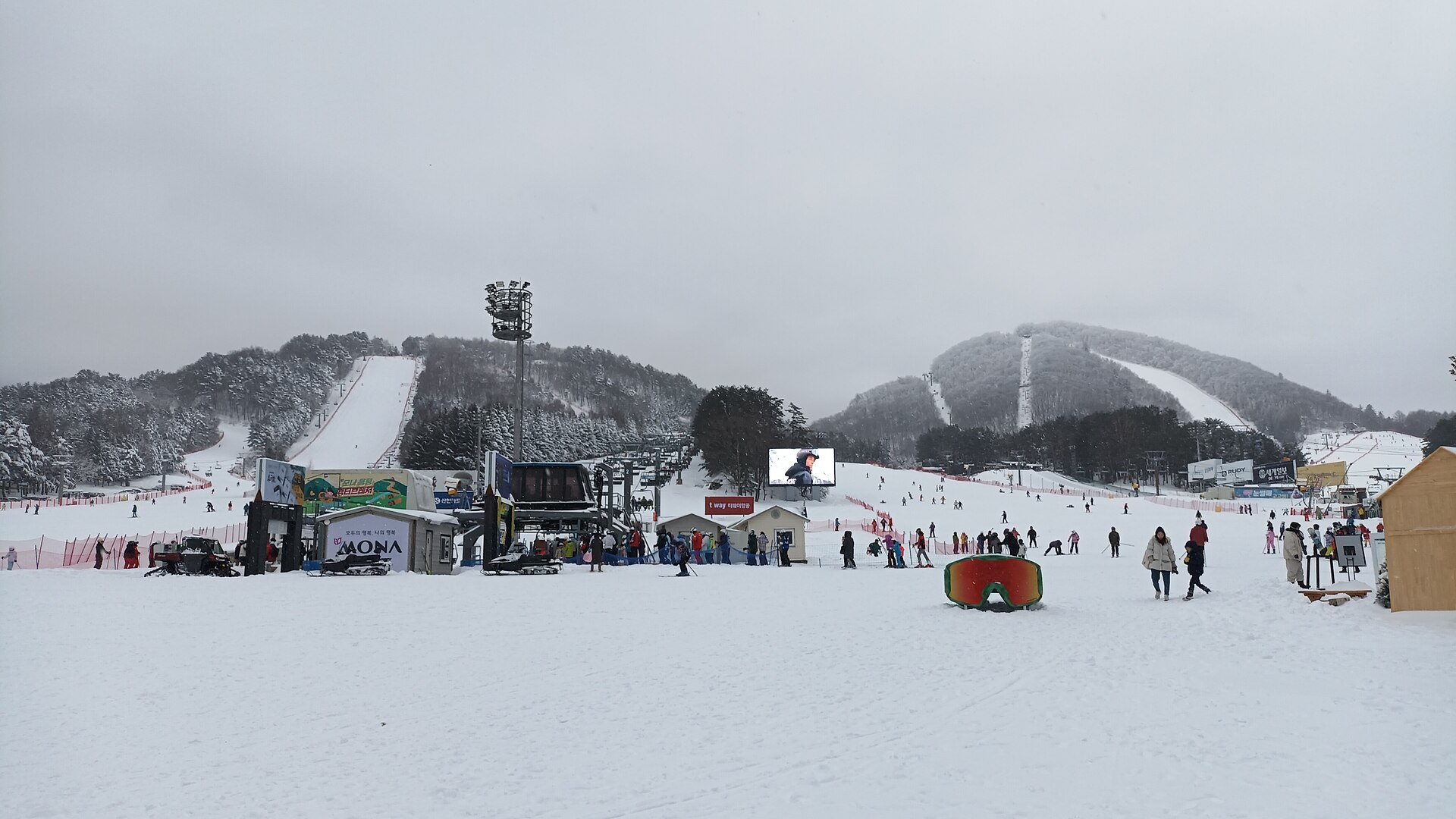
    Yongpyong ski resort base area and slopes, Pyeongchang
    The base area and slopes at Yongpyong in February 2024. Photo: Dittwjfsdgkvkdjg, CC BY-SA 4.0, via Wikimedia Commons.

    My rule for first timers: stay in the Yellow and Green zones on day one, even if a friend swears Pink is easy. For experts, the Rainbow runs are the reason to come; ski them early before the snow gets scraped.

    Panorama shot of Yongpyong resort ski runs in early March
    Panorama shot of Yongpyong resort ski runs in early March, 2013. Photo: Kalatpadai, CC0, via Wikimedia Commons.

    Options With Opinions

    Option Best For Cost (2025/26) Time My Take
    Shuttle day trip, 8:45am bus, half day First timers 44,000 won bus return plus 68,000 won half day Back in Seoul by evening My pick for day one
    Shuttle day trip, 5:25am bus, full day Keen skiers 44,000 won plus 96,000 won Long day, tired legs Only if you already ski
    KTX to Jinbu plus overnight Two or three days on snow Check Korail+ About 1.5 to 2 hours on the train Best for a proper ski holiday
    Night skiing only Hotel guests 68,000 won 7pm to 11pm Skip on your first day

    Getting There

    By shuttle (season only). The shuttle timetable lists buses from Hongik University Station (Line 2, green; AREX, blue) Exit 8 at 5:25am and 8:50am, Sinchon Station (Line 2, green) Exit 7 at 5:30am and 8:55am, Myeong-dong Station (Line 4, sky blue) Exit 1 at 5:25am and 8:45am, Doota in Dongdaemun, and Sports Complex Station (Line 2, green; Line 9, gold) Exit 6 at 6:20am and 10am, where all routes gather. From Gangnam, ride Line 2 (green) four stops east to Sports Complex. Fares are 22,000 won each way for adults and 16,000 won for children; returns leave the resort at 1pm and 5pm. Book online; there are no tickets at the stop.

    By KTX. KTX trains on the Gangneung Line run from Seoul Station and Cheongnyangni to Jinbu (Odaesan) Station in about 1.5 to 2 hours, then it is a taxi to the resort. Book on Korail+.

    By express bus. Yongpyong’s transport page lists buses from Dong Seoul Terminal to Hoenggye roughly every 35 minutes, about 2.5 hours, at 14,500 won for adults, then a 1,200 won local bus or a short taxi to the resort.

    By car. Take the Yeongdong Expressway to Hoenggye IC; the resort is about 10 minutes beyond.

    Use a T-money card or tourist pass for the subway leg to the stop.

    Where To Go On The Mountain

    Dragon Plaza (드래곤플라자): the main base building with ticket offices, rental and the cable car platform. Rental keeps your ID until you return gear.

    Balwangsan Cable Car (발왕산 관광케이블카): the cable car page calls its 7.4 km round trip the longest course in Asia; 9am to 5pm. Up top is Dragon Castle, a café and restaurant at 1,458 m. Non skiers can ride it too.

    Daegwallyeong Sheep Farm (대관령양떼목장): a short drive away, a classic snowy walk if someone in your group does not ski.

    Yongpyong ski resort in December, Pyeongchang
    Yongpyong in December. Photo: Mkckim, CC BY-SA 3.0, via Wikimedia Commons.

    Safety Heads Up

    Heads Up: Daegwallyeong wind chill is brutal. With an average January low around minus 12°C, wind on the top lifts makes it feel far colder. Cover every bit of skin and take a warm break each hour.

    Wear a helmet, rented or your own; beginner slopes are where collisions happen. Stop at the side of the run, never in the middle, and do not sit below a ridge where riders cannot see you. On lifts, lower the bar and keep phones in zipped pockets. Korean resorts have first aid and ski patrol on site, and serious injuries go to hospital, so buy travel insurance that covers skiing before you fly. Roads around Hoenggye can carry black ice early morning; if you drive, carry chains and go slow.

    What Locals Know

    Weekdays are a different mountain. Korean office workers ski weekends and the week between Christmas and New Year. Come Tuesday to Thursday and lift queues and lesson groups shrink.

    The resort calls itself MONA YongPyong now, but every Korean says 용평 (Yongpyong). Search 용평리조트 in Naver Map.

    Hoenggye is the town, the resort is the mountain. Hoenggye, about 10 minutes away, is where the express bus stops and where cheaper rooms and restaurants are; the local bus to the resort costs 1,200 won. Back in Seoul, a winter street food stop is the reward.

    Pick Your Version

    If It’s Your First Time

    I’d book the 8:45am shuttle, the 1pm half day pass and the 2pm group lesson. You meet your instructor fresh, and you are on the 5pm bus home before your legs give out.

    If You’re Bringing Kids

    Children 8 and up can join English group lessons; 6 and 7 year olds go one to one (300,000 won per team last season). I’d book a private lesson for small kids and plan the cable car as the reward. More ideas in Seoul with kids in winter.

    If You’re Travelling Solo

    The shuttle and group lesson do the social part. I’d go midweek and book a Hoenggye hotel for one night so you can ski the morning freshly groomed.

    Sunbae’s Picks

    My pick for a first day: half day plus group lesson, as above.

    My pick for strong skiers: two nights on the mountain and the Rainbow runs first thing. Then compare with High1’s long runs on another trip.

    I’d skip booking night skiing on day one. You will be too tired and the last Seoul shuttle leaves at 5pm.

    If snowboarding is your thing, read my snowboarding guide before booking: English board lessons here are private only.

    Offers Worth Knowing

    Children 13 and under get lower lift, rental and shuttle prices. The half day ticket saves 28,000 won on the adult day pass. Renting the suit saves packing a ski outfit.

    What’s Changing In 2026

    Openings have crept earlier: 24 November in 2023, 29 November in 2024 and 21 November in 2025, which inews24 noted was a week earlier than the year before. The industry is also shrinking around Yongpyong: a January 2026 Daum report (in Korean) counted three resorts near Seoul closed in four years and put national skier visits at about 4.43 million in 2024, well below the 6.86 million peak. My read: the big Gangwon mountains are where the investment and the snow are, so Yongpyong will stay busy on weekends. Pick weekdays.

    Worth It Or Skip It

    Worth It: a midweek day in January on the Paradise runs, with the cable car at lunch.

    Skip It: opening week if you are flying in mainly to ski. Wait for December. If you just want snow scenery, see where to see snow in Korea.

    Word Of The Stop

    초보 (chobo), “beginner”. Say “chobo imnida” (I am a beginner) at rental and the lesson desk. Beginner slopes are marked 초급 (chogeup).


    Map And Directions

    1. 1
      MONA YongPyong (Dragon Plaza base area) 모나용평 드래곤플라자

      Main base: tickets, rental, cable car platform. 2025/26 adult day pass 96,000 won; day 9am to 5pm, night 7pm to 11pm

    2. 2
      Balwangsan summit (Dragon Castle, cable car top) 발왕산 드래곤캐슬

      1,458 m; cable car 7.4 km round trip, 27,000 won adult return last season, 9am to 5pm

    3. 3
      Hoenggye Intercity Bus Terminal 횡계시외버스터미널

      Express buses from Dong Seoul about every 35 min, about 2.5 hours, 14,500 won adult; local bus to Yongpyong 1,200 won

    4. 4
      Jinbu (Odaesan) Station 진부(오대산)역
      Jinbu (Odaesan) Station

      KTX from Seoul and Cheongnyangni in about 1.5 to 2 hours; taxi to the resort

    5. 5
      Yongpyong shuttle stop, Hongik University Station 홍대입구역 8번 출구 스타벅스 홍대공항철도역점Area pin
      2Hongik University StationEXIT8

      Walk about 130 m to Starbucks; buses 5:25am and 8:50am; 22,000 won each way; book online

    6. 6
      Daegwallyeong Sheep Farm 대관령양떼목장

      Snowy walk nearby for non skiers; check opening before you go

    Your Tickets

    Shuttle셔틀
    Hongik University Exit 8 / Sinchon Exit 7 / Myeong-dong Exit 1 / Doota / Sports Complex Exit 6→MONA YongPyong
    Timetraffic dependent; check the operator
    Fare22,000 won each way adult, 16,000 won child
    Seoul shuttles scheduled 27 Nov 2026 to 1 Mar 2027; returns 1pm and 5pm; book online only
    SEOUL SUNBAE3134-1승차권
    KTX고속열차
    Seoul Station or Cheongnyangni→Jinbu (Odaesan) Station
    Timeabout 1.5 to 2 hours
    Farecheck Korail+
    Then taxi to the resort
    SEOUL SUNBAE3134-2승차권
    Express bus고속버스
    Dong Seoul Bus Terminal→Hoenggye
    Timeabout 2.5 hours
    Fare14,500 won adult
    About every 35 minutes per the resort's page
    SEOUL SUNBAE3134-3승차권
    Green bus지선
    Hoenggye→MONA YongPyong
    Timeabout 10 to 15 min
    Fare1,200 won
    Hoenggye local bus; a few runs a day, see the resort's timetable
    SEOUL SUNBAE3134-4승차권

    Seoul area bus colours: Blue bus · 간선 Green bus · 지선 Red bus · 광역 Yellow bus · 순환

    Get the map appsNNaver Map App Store Google PlayKKakaoMap App Store Google PlayBoth work in English. With the app installed, the Naver Map and KakaoMap buttons open directions straight to the pin.

    Tap a button to open directions on your phone. In Korea, Naver Map and KakaoMap give full walking directions; Google Maps covers subway and bus but, as of September 2026, still has no turn by turn walking or driving here. Pins marked “Area pin” show a neighbourhood, not a door.

    Frequently Asked Questions

    When Does Yongpyong Open For 2026/27?

    Scheduled for 27 November 2026, weather permitting, Korean news reported on 5 November. It opened on 24 November 2023, 29 November 2024 and 21 November 2025, and Seoul shuttles are scheduled from 27 November 2026.

    How Much Is A Yongpyong Lift Ticket?

    In 2025/26 an adult day pass cost 96,000 won and a half day or night pass 68,000 won. Children paid 78,000 and 56,000 won. New prices usually appear in November.

    Is Yongpyong Good For Beginners?

    Yes. It has dedicated beginner zones (Yellow, New Yellow, Mega Green) and English group lessons for first timers aged 8 and up.

    How Do I Get To Yongpyong From Seoul?

    Take the seasonal shuttle from Hongdae, Sinchon, Myeong-dong, Dongdaemun or Sports Complex (22,000 won each way), KTX to Jinbu then a taxi, or an express bus from Dong Seoul to Hoenggye.

    Can Non Skiers Visit Yongpyong In Winter?

    Yes. The Balwangsan Cable Car (27,000 won return for adults last season) runs to Dragon Castle at 1,458 m, and the resort has a sled area.

    Next Stop

    Still choosing between resorts? Start with ski resorts near Seoul.

    Resources

    How I Checked This

    On 12 November 2026 I checked the 2026/27 opening plans in Korean news. On 14 October 2026 I checked Yongpyong’s English price, rental, lesson, cable car, overview, transport and slope status pages, the shuttle partner’s timetable and season dates, last three seasons’ openings and the 2025 closing schedule in Korean news, and Daegwallyeong KMA normals. Still unconfirmed: the actual 2026/27 opening day, which can slip in a warm spell, and prices, the actual 2024 and 2026 closing dates, and current KTX fares.

    Sources


    Written by your sunbae. Over 20 years in Korea. We learned the lessons the hard way, so you don’t have to, and we’re here to guide you and help you enjoy Korea. Every fact here is checked against official sources and, wherever possible, on the ground.

    Beep Check: verified 14 Oct 2026. Rules, prices and dates change; confirm with the official source before you travel.

  • Korea’s Winter Weather By Region: Seoul, Gangwon, Busan And Jeju

    Korea’s Winter Weather By Region: Seoul, Gangwon, Busan And Jeju

    TL;DR

    Korean winter runs from early December to late February. Seoul averages 0.2°C in December, −1.9°C in January and 0.7°C in February, with nights around −3 to −6°C. Inland Gangwon is far colder (Daegwallyeong averages −7.0°C in January), while Busan and Jeju stay above freezing. Snow is most reliable in the Gangwon mountains and least likely in Busan.

    Last checked: 14 Oct 2026 What is a Beep Check?

    Sunbae Says: Pack for the wind, not the thermometer. A −5°C morning in Seoul with a northwesterly feels much colder than the number on your weather app, and the cold is drier and sharper than most visitors expect.

    You step out of your hotel at 8am in January. The app says −6°C, the wind is coming straight down the street, and you suddenly understand why everyone on the subway is wearing a knee length padded coat. This guide tells you where in Korea that happens, and where it does not.

    Gyeongbokgung Palace in Seoul covered in snow
    Gyeongbokgung Palace after a December snowfall. Photo: Republic of Korea (Korea.net), CC BY-SA 2.0, via Wikimedia Commons.

    The Table: Winter By Region

    These are the official 1991 to 2020 climate normals (평년값) from the Korea Meteorological Administration (KMA), station by station. Format: monthly mean, then average daily high and low, in °C. “Snow days” are days when snow was observed falling, not days with snow on the ground.

    Station (Region) December January February Snow Days Dec / Jan / Feb
    Seoul (capital) 0.2 (4.2 / −3.4) −1.9 (2.1 / −5.5) 0.7 (5.1 / −3.2) 6.4 / 7.1 / 5.1
    Chuncheon (Yeongseo, inland Gangwon) −2.0 (3.5 / −6.6) −4.1 (1.9 / −9.3) −1.0 (5.4 / −6.7) 6.7 / 8.8 / 6.3 *
    Cheorwon (northern Gangwon) −3.2 (2.7 / −8.6) −5.7 (0.7 / −11.8) −2.3 (4.1 / −8.6) 7.3 / 9.2 / 6.2 *
    Daegwallyeong (Pyeongchang, ski country) −4.5 (0.5 / −9.4) −7.0 (−1.8 / −12.2) −4.6 (0.6 / −10.1) 10.9 / 13.0 / 11.8 *
    Taebaek (high Gangwon) −2.3 (3.0 / −7.1) −4.7 (0.7 / −9.6) −2.5 (3.1 / −7.8) 7.6 / 10.7 / 9.7 *
    Gangneung (Yeongdong, east coast) 3.3 (7.7 / −0.5) 0.9 (5.3 / −2.7) 2.7 (7.1 / −1.3) 2.9 / 6.0 / 6.0 *
    Jeonju (Jeolla) 2.2 (7.1 / −2.1) 0.0 (4.8 / −4.3) 2.0 (7.5 / −2.8) 7.2 / 8.3 / 5.0
    Gwangju (Jeolla, near the west coast snow belt) 3.2 (8.0 / −0.8) 1.0 (5.7 / −2.7) 2.9 (8.3 / −1.5) 8.4 / 9.9 / 6.3
    Daegu (southeast) 3.0 (7.9 / −1.2) 1.1 (5.9 / −2.9) 3.5 (8.8 / −1.1) 3.0 / 4.2 / 2.2
    Busan (south coast) 5.8 (10.4 / 2.0) 3.6 (8.2 / −0.1) 5.4 (10.2 / 1.5) 0.9 / 1.4 / 1.2
    Jeju City (north coast of Jeju) 8.3 (11.0 / 5.6) 6.1 (8.6 / 3.7) 6.8 (9.9 / 4.0) 5.3 / 7.2 / 4.2

    * Snow days marked with an asterisk are KMA’s 1981 to 2010 normals, the latest published for that station in the table I used. Seoul’s monthly means are from KMA’s own release on the new normals (in Korean); the other stations come from KMA’s normals as reproduced in each station’s climate table. Treat everything as approximate to a few tenths of a degree.

    That same KMA release says Korea’s winter is now 87 days long, starting around 4 December and ending around 28 February, a week shorter than under the old normals.

    Why The Regions Differ So Much

    Yeongseo vs Yeongdong. Gangwon is split by the Taebaek mountain range. West of it (Yeongseo: Chuncheon, Hongcheon, Cheorwon, Pyeongchang) the cold continental air pools in valleys, which is why Cheorwon’s January nights average −11.8°C. East of it (Yeongdong: Gangneung, Sokcho) the sea keeps things milder, so Gangneung’s January mean is almost 5°C warmer than Chuncheon’s, at roughly the same latitude.

    East coast snow comes late and comes big. Yeongdong snow often arrives in February and March, when northeasterly winds push moisture off the East Sea into the mountains. In February 2011 Gangneung recorded 77.7 cm of new snow in a single day, Kyunghyang Shinmun reported (in Korean), and seven of the nine Gangwon snowfalls of 20 cm or more between 2000 and 2011 fell in February or March. If you want deep snow on the coast, late winter is your window.

    The west coast snow belt. When cold air crosses the relatively warm Yellow Sea, the temperature gap between sea and air (해기차) builds bands of snow cloud that dump on the Jeolla and Chungnam west coast and Jeju’s mountains. In December 2022 KMA forecast 20 cm or more (in Korean) for parts of the Honam west coast and 50 cm or more on Jeju’s mountain while Seoul expected under 1 cm. That is why Gwangju logs more snow days than Seoul despite being warmer.

    Busan and the southeast stay dry and sunny. Busan averages barely one snow day a month in winter. Expect cold, bright, windy days rather than snow.

    Jeju is two climates. Jeju City by the sea rarely freezes, but Hallasan, South Korea’s highest mountain, gets proper alpine winter, with winter trail cut off times on its trails. My Jeju in November guide covers the island’s shoulder season, and where to see snow in Korea covers Hallasan in winter.

    Daegwallyeong Snow Festival 02
    Daegwallyeong Snow Festival 02, 2017. Photo: Republic of Korea from Seoul, Republic of Korea, CC BY-SA 2.0, via Wikimedia Commons.

    Seoul’s First Snow

    Seoul’s normal first snow date is around 20 November, measured by an observer at the Seoul Weather Observatory in Songwol-dong, Jongno-gu, who has to see it fall. Recent winters:

    Winter Seoul’s First Snow Note
    2023/24 17 November 2023 3 days earlier than normal
    2024/25 26 November 2024 Followed by 18.0 cm on 27 November, the most for any November day since records began in 1907
    2025/26 4 December 2025 Heavy bursts of 5 cm an hour; 19 roads closed that evening

    Sources: Segye Ilbo on 2024 (in Korean) and on 2023, Kyunghyang Shinmun on the November 2024 record (in Korean), and the December 2025 report (in Korean). The lesson: a first snow can be a dusting or a disaster, and it can come any time from mid November to early December.

    Heads Up: A heavy first snow can gridlock Seoul. On 4 December 2025, 19 roads closed and traffic in the city centre crawled at 5.9 km/h; on a snow day, take the subway, not a taxi or airport bus with a tight connection.

    Cold Waves, Wind Chill And Black Ice

    KMA issues a cold wave advisory (한파주의보) when the morning low is expected to stay at −12°C or below for two days or more, and a cold wave warning (한파경보) at −15°C or below, according to the Hanam city government’s summary of the criteria (in Korean). Under the 1991 to 2020 normals, Seoul gets about 3.1 days a year with a morning low of −12°C or below.

    Last winter shows how it plays out. KMA’s 2025/26 winter summary (in Korean) found the season 0.6°C warmer than normal overall, with December 1.3°C warmer and February 1.5°C warmer, but January 0.7°C colder thanks to an Arctic cold spell lasting more than ten days. It was also very dry nationally: 53 percent of normal precipitation and 14.7 cm of snow against a normal 26.4 cm.

    Heads Up: Black ice is the real winter danger in Korea, on pavements, bridges and mountain roads. After a melt and refreeze, walk on the gritted strip, hold the handrail on subway steps, and think twice before a self drive trip into Gangwon on a cold wave morning.

    Wind chill makes the difference. A northwesterly on an open bridge or a ski slope can make −5°C feel like −15°C. Korean weather apps show 체감온도 (feels like) next to the real temperature: dress for that number.

    Fine Dust And Yellow Dust

    Winter is fine dust season, not just cold season. Korea runs a seasonal fine dust management period (in Korean) from December to March because concentrations typically rise in those months; the seventh round ran December 2025 to March 2026, with the most polluting old vehicles restricted in the capital region and coal plants throttled back.

    Yellow dust (황사), sand blown in from deserts to the west, is mainly a March and April problem, but it can hit in winter: in February 2015 Seoul’s PM10 reading hit 1,044 µg/m³ in the worst winter yellow dust in five years (in Korean). If you are sensitive, check the AirKorea app each morning and carry a KF94 mask.

    This is the appearance of downtown Seoul on May 7, 2021, when there was a lot of fine dust
    This is the appearance of downtown Seoul on May 7, 2021, when there was a lot of fine dust, 2021. Photo: Hyeonyoung Lee 21, CC BY-SA 4.0, via Wikimedia Commons.

    This Winter’s Outlook

    KMA’s three month outlook issued on 23 September 2026 (in Korean) gives a 50 percent chance that December 2026 will be warmer than normal (normal range 0.5 to 1.7°C nationally), 40 percent similar and 10 percent colder. My read: expect a mild start with sharp cold snaps, which is exactly when black ice forms. Outlooks for January and February come later; I post updates on what’s on.

    What It Means For Your Packing

    For Seoul in December to February you want a long padded coat, a warm hat, gloves you can use a phone in, thermal base layers and boots with grip. For Gangwon ski country add a neck gaiter and goggles; the ski resorts near Seoul guide explains what to rent instead of pack. For Busan and Jeju, a warm jacket and layers usually do it. My full list is in what to wear in Korea in autumn and winter.

    What Locals Know

    Koreans dress for the morning low. After more than 20 winters here, I can tell you the long padded coats come out the week Seoul’s mornings first dip below zero, whatever the afternoon brings.

    “Three cold days, four warm days” (삼한사온) is still how people talk about winter. The idea is that cold snaps arrive in bursts and then ease, so a brutal morning is rarely the whole week.

    Heated floors are the cure. Korean homes, guesthouses and jjimjilbang floors are heated, and that is where locals thaw out. A hot fish cake from a street food cart helps too.

    Snow alerts arrive by text. In December 2025 KMA sent Seoul its first heavy snow emergency text of the season when 5 cm fell in an hour. Your phone will buzz in Korean; a translation app makes sense of it, and my travel apps guide sets one up.

    Pick Your Version

    If It’s Your First Time

    I’d base yourself in Seoul and make one snow trip to Gangwon. Seoul has real winter without the extremes, and a day in Pyeongchang shows you the deep cold. Korea in December has the month’s events.

    If You’re Bringing Kids

    Plan indoor mornings and outdoor afternoons, when it is a few degrees warmer. My Seoul with kids in winter guide is built around that rhythm.

    If You’re Travelling Solo

    February is when the east coast snow tends to arrive. I’d pair Gangneung with a festival from my winter ice festivals guide.

    If You’re Here For A Reset

    Cold dry air, heated floors and hot baths are the Korean winter wellness routine. If fine dust bothers you, keep an eye on the morning reading and plan indoor days when it spikes.

    Sunbae’s Picks

    My pick for snow you can count on: Daegwallyeong, with more than ten snow days a month on the old normals and the ski season to match. The ski season calendar shows when the resorts open.

    If I wanted mild winter sightseeing, I’d go to Busan: January means of 3.6°C and almost no snow.

    I’d skip planning around a white Christmas in Seoul. It happens, but the first snow is often a dusting and last December was warmer than normal.

    My late winter move: Gangneung in February for coastal snow, a warm café and the sea.

    Word Of The Stop

    한파 (hanpa), “cold wave”. You will hear it on the news and see 한파주의보 (cold wave advisory) in alerts. When it appears, layer up and allow extra time on icy pavements.


    Map And Directions

    1. 1
      Seoul Weather Observatory (Songwol-dong) 서울기상관측소

      Where Seoul's first snow is officially observed by eye; normal first snow about 20 Nov; January mean −1.9°C (1991 to 2020)

    2. 2
      Daegwallyeong weather station 대관령 기상관측소Area pin

      Korea's classic cold and snow station; January mean −7.0°C, mean low −12.2°C (1991 to 2020)

    3. 3
      Chuncheon weather station 춘천 기상관측소Area pin

      Inland Yeongseo cold: January mean −4.1°C, mean low −9.3°C

    4. 4
      Gangneung weather station 강릉 기상관측소Area pin

      Milder east coast (January mean 0.9°C) but big February and March snowfalls

    5. 5
      Busan weather station 부산 기상관측소Area pin

      January mean 3.6°C, about one snow day a month in winter

    6. 6
      Jeju weather station (Jeju City) 제주 기상관측소Area pin

      January mean 6.1°C at sea level; Hallasan above has deep snow and winter trail cut off times

    Your Tickets

    KTX고속열차
    Seoul Station or Cheongnyangni→Gangneung
    Timecheck Korail+
    Farecheck Korail+
    East coast snow trip, best in February
    SEOUL SUNBAE3145-1승차권
    KTX고속열차
    Seoul Station or Cheongnyangni→Jinbu (Odaesan) or Pyeongchang
    Timeabout 1.5 hours to Jinbu
    Farecheck Korail+
    For Daegwallyeong cold and ski country
    SEOUL SUNBAE3145-2승차권
    Get the map appsNNaver Map App Store Google PlayKKakaoMap App Store Google PlayBoth work in English. With the app installed, the Naver Map and KakaoMap buttons open directions straight to the pin.

    Tap a button to open directions on your phone. In Korea, Naver Map and KakaoMap give full walking directions; Google Maps covers subway and bus but, as of September 2026, still has no turn by turn walking or driving here. Pins marked “Area pin” show a neighbourhood, not a door.

    Frequently Asked Questions

    What Is The Coldest Month In Korea?

    January. Seoul’s 1991 to 2020 January mean is −1.9°C, and inland Gangwon is colder: Daegwallyeong averages −7.0°C, with mean lows of −12.2°C.

    Does It Snow In Seoul?

    Yes, on about six or seven days a month in December and January on the 1991 to 2020 normals, but it often melts within a day. The first snow usually comes around 20 November.

    Does It Snow In Busan?

    Rarely: about one snow day a month in winter. Expect cold, dry, sunny days.

    Is Jeju Warm In Winter?

    Milder, not warm. Jeju City averages 6.1°C in January, but Hallasan has deep snow and winter trail rules.

    When Is Fine Dust Worst In Korea?

    Fine dust tends to rise from December to March, which is why Korea runs a seasonal management period then; yellow dust peaks in March and April.

    Next Stop

    Resources

    • KMA English site: forecasts, warnings and cold wave alerts.
    • Naver Weather or another Korean weather app: hourly forecasts with 체감온도 (feels like).
    • AirKorea: live fine dust readings in English.
    • 1330 Korea Travel Hotline: dial 1330 (or +82-2-1330 from abroad) for English help, 24 hours.

    How I Checked This

    On 14 October 2026 I took monthly temperature and snow day normals from KMA’s 1991 to 2020 climate normals, using KMA’s own release for Seoul and KMA sourced station climate tables for the rest, because the KMA data portal would not load from my connection. I checked first snow dates against Segye Ilbo and Kyunghyang reports of KMA observations, cold wave criteria against a city government page, and last winter and this winter against KMA’s own summary and outlook. Still approximate: snow days for some Gangwon stations are 1981 to 2010 figures, and January and February 2027 outlooks were not yet issued.

    Sources


    Written by your sunbae. Over 20 years in Korea. We learned the lessons the hard way, so you don’t have to, and we’re here to guide you and help you enjoy Korea. Every fact here is checked against official sources and, wherever possible, on the ground.

    Beep Check: verified 14 Oct 2026. Rules, prices and dates change; confirm with the official source before you travel.

  • Korea In December 2026: Lanterns, Christmas Markets And Snow

    Korea In December 2026: Lanterns, Christmas Markets And Snow

    TL;DR

    December in Korea is cold, dry and bright. Seoul averages 4.2°C by day and minus 3.4°C at night, with about six snowy days in the month. In return you get the Seoul Winter Festival from 11 Dec, a Christmas market at Gwanghwamun, lanterns on Cheonggyecheon, a 1,000 won ice rink, the first ski runs and a Christmas that feels more like Valentine’s Day. Dress for minus five.

    Last checked: 22 Oct 2026 What is a Beep Check?

    Sunbae Says: Base yourself near City Hall or Gwanghwamun in December. The market, the lanterns, the ice rink and the Bosingak bell are all a short walk apart, so you never stand on a freezing bus platform.

    Snow-covered rooftops, cars and bare trees on a steep residential street at night, lit by warm street lights.
    Fresh snow on a hillside neighbourhood near Namsan at night. Photo: your sunbae

    December Weather In Korea: What To Expect

    Picture it: 6pm, already dark, minus two, and the wind coming straight down Sejong-daero. Five minutes later you are in a market tent holding something hot.

    These are 1991 to 2020 averages from the Korea Meteorological Administration.

    City Avg High Avg Low Rain Or Snow Snow Days
    Seoul 4.2°C minus 3.4°C 23 mm 6.4
    Busan 10.4°C 2.0°C 34 mm 0.9
    Jeju City 11.0°C 5.6°C 56 mm 5.3

    Seoul gets only about 23 mm of precipitation in December. That means lots of blue sky, but also dry air: bring lip balm and hand cream. Snow is possible, but it is usually light and melts off the main roads fast. If you want a white Christmas you can count on, you want the mountains of Gangwon, not the capital.

    Busan and Jeju stay above freezing on average, which makes them the soft option with small kids. Landing in late November instead? Start with Korea In November 2026.

    Winter jasmine in Seoul Forest, South Korea
    Winter jasmine in Seoul Forest, South Korea, 2024. Photo: WANGYIFAN2024, CC0, via Wikimedia Commons.

    Early, Mid Or Late December? Pick Your Week

    Option Best For Cost Time My Take
    1 to 10 Dec Cheaper flights, first lights, quiet palaces Lowest 5 to 7 days Festival may be half built. Fine for food and palaces.
    11 to 23 Dec Market, lanterns and rink all running Mid 5 to 8 days My pick. Everything is on and Christmas week prices have not hit yet.
    24 to 27 Dec Couples, Christmas Eve dinners Highest Long weekend Book restaurants weeks ahead or eat at 5pm.
    28 to 31 Dec Countdown, Bosingak bell High 4 days plus Exciting, but crowds and road closures on the 31st.

    If you can choose, fly in around 18 Dec. The Gwanghwamun Market and the lanterns are listed from 11 Dec and the Seoul Plaza rink from 18 Dec, so you get the full set without the Christmas weekend squeeze.

    The Seoul Winter Festival: 11 Dec 2026 To 31 Jan 2027

    This is the big one. As of 22 Oct 2026 the Seoul festival portal lists it for 11 Dec 2026 to 31 Jan 2027 at Gwanghwamun Square and six other locations, a week later than the 4 Dec it showed earlier this month. The Seoul Winter Festival official site (in Korean) lists the Gwanghwamun Market and Seoul Light Gwanghwamun from 11 Dec to 10 Jan, the lanterns and Seoul Light DDP from 11 Dec to 31 Jan, and the Seoul Plaza rink from 18 Dec to 9 Feb. Hours and the full programme are not out yet. Ride Line 5 (purple) to Gwanghwamun Station; Exit 2 puts you on the square.

    The listing names seven parts: Seoul Light Gwanghwamun (a media facade, light sculptures and a New Year countdown), the Gwanghwamun Market with Christmas stalls, the Bosingak bell ceremony, the Seoul Lantern Festival on Cheonggyecheon, Seoul Light DDP with a media facade and a Christmas town, SeoulCon with K-beauty and K-pop events, and the Seoul Plaza ice rink. Most of it is free. For exact nights, watch my events calendar.

    Worth It: the Gwanghwamun Market after dark. Last season it ran 12 to 31 Dec, 6pm to 10pm, and stayed open to midnight on New Year’s Eve, so plan your evenings, not afternoons. This season it is listed for 11 Dec to 10 Jan; the 2026 hours are not published yet. Skip It: DDP in daylight. The building is striking, but the light show is the reason to go, and it only works at night. DDP is at Dongdaemun History and Culture Park Station (Lines 2 green, 4 sky blue and 5 purple), Exit 1.

    Seoul Lantern Festival On Cheonggyecheon

    The lanterns are Seoul’s biggest winter draw. Hanji (Korean paper) lanterns and light art line Cheonggyecheon, and the official festival page still says only “December” for 2026. Last season ran 12 Dec 2025 to 18 Jan 2026 along Cheonggyecheon and Uicheon, according to VisitKorea’s winter festival guide, and Korean media reported a record 3.83 million visitors over its run. Expect a similar mid December start.

    Start at Cheonggye Plaza: Gwanghwamun Station (Line 5, purple) Exit 5, or City Hall Station (Lines 1 dark blue and 2 green) Exit 4. Walk east with the flow. My full guide: Seoul Lantern Festival 2026.

    Heads Up: Weekend evenings on Cheonggyecheon move at shuffle speed for the first stretch near Cheonggye Plaza. Go on a weeknight after 8pm, or start further east and walk back west.

    Christmas In Korea: Couples, Crowds And Lights

    Christmas Day, Friday 25 Dec, is a public holiday, so you get a long weekend. Here is the part first timers miss: Christmas here is a date night. Restaurants in Myeongdong, Hongdae, Gangnam and Seongsu fill with couples, so book a nice Christmas Eve dinner weeks ahead.

    The Shinsegae department store facade in Myeongdong is Seoul’s famous Christmas light show, usually switched on in November and kept running past New Year. Take Line 4 (sky blue) to Hoehyeon Station, Exit 7. The 2026 show started on 6 November and runs daily from 5pm to midnight until 31 January 2027, per Aju Business Daily (in Korean). My full plans are in Christmas In Seoul 2026, and the market by market rundown is in Seoul Christmas Market 2026.

    Ice Skating On Seoul Plaza

    The Seoul Plaza rink is part of the Winter Festival listing again. Last season it opened on 19 Dec 2025 and ran 52 days to 8 Feb, with admission at 1,000 won, unchanged since the rink first opened in 2004, skates included. It opened 10am to 9:30pm on weekdays and to 11pm on Saturdays. This season it is listed for 18 Dec 2026 to 9 Feb 2027 on the Seoul Winter Festival official site (in Korean); the 2026 prices are not confirmed yet. It is outdoors, so bad air or heavy snow can close a session. Take City Hall Station (Lines 1 dark blue and 2 green) and follow the signs for Seoul Plaza.

    Skiing And Snow Trips

    Gangwon resorts usually open between late November and early December, as soon as snowmaking allows. High1 opened on 28 Nov last season and O2 Resort on 5 Dec. No resort has announced a 2026 opening day yet, although 2026 to 2027 season passes are already on sale. If it is your first time on skis, December is fine for a beginner day, but January has the more reliable snow. See Your First Ski Trip In Korea.

    Winter fishing festivals like the Hwacheon Sancheoneo Ice Festival start in January (10 Jan last season), so they are not a December trip. Hwacheon County is already marketing the 2027 edition to foreign visitors, but the dates are not out.

    New Year’s Eve

    The Bosingak bell in Jongno rings 33 times at midnight on 31 Dec. Last year police expected about 100,000 people, closed roads from 6pm to 7am, and Line 1 (dark blue) trains skipped Jonggak Station from 11pm to 1am (in Korean). I have calmer alternatives in New Year’s Eve In Seoul.

    Heads Up: If you plan to watch the bell, do not aim for Jonggak Station. Get off at City Hall or Gwanghwamun before 10pm and walk, and expect the same skip stop rule again this year.

    What Locals Know

    The festival grows up in stages. The festival now starts on 11 Dec, and the pieces still arrive in waves: last season the market and lanterns opened on 12 Dec 2025 and the rink on 19 Dec, and this season the rink is listed from 18 Dec. Plan your big downtown night for mid December, not the first weekend.

    There is a new photo spot for the Shinsegae facade. Seoul and Jung District swapped the solid railings at the underground passage entrance in front of the Central Post Office for clear glass in July 2026, reports Hankyung (in Korean), so you can shoot the facade without a wall in the frame.

    The rink price includes more than skates. Last season the 1,000 won ticket covered skates, a helmet and knee pads, and opening day was free. Saturdays run to 11pm, but weekday mornings are calmest.

    Getting There

    From Incheon Airport, take the AREX (blue) all stop train to Seoul Station, about an hour from Terminal 1, then Line 1 (dark blue) two stops to City Hall. Pay with a T-money card or tourist pass loaded at the airport. Airport limousine buses also run to the big City Hall and Gwanghwamun hotels; check the stop on Naver Map.

    Once you are downtown, walk. Gwanghwamun Square to Seoul Plaza is about 10 minutes, Seoul Plaza to Cheonggye Plaza about 5, and Cheonggye Plaza to Bosingak about 10. For DDP, take Line 2 (green) from City Hall to Dongdaemun History and Culture Park, about 10 minutes. A 1 to 7 day tourist pass covers all of this; my transit card guide explains which one to buy.

    Pick Your Version

    If It’s Your First Time: I’d come between 18 and 23 Dec. The market, lanterns and rink should all be running, and you beat the Christmas weekend rush on restaurants.

    If You’re Bringing Kids: I’d skip the Bosingak crowd entirely and do the Seoul Plaza rink on a weekday morning, then warm up indoors. If your children hate the cold, add a few days in Busan, where daytime highs average 10°C.

    If You’re Travelling Solo: I’d make December your food month. Street carts, market tents and warm soups are made for one person, and Christmas Eve is the one night to book or eat early.

    Sunbae’s Picks

    My pick for one perfect December evening: Gwanghwamun Market at dusk, then a walk down Cheonggyecheon under the lanterns, then fish shaped bungeoppang from a cart. All walkable, almost all free.

    I’d skip a December ski day if you only have a week. January snow is more reliable.

    After more than 20 winters here, my rule is simple: eat what the carts sell, because it tells you the season better than any guidebook. My favourites are in Korean Winter Street Food.

    Offers Worth Knowing

    Most of the Seoul Winter Festival is free, and the Seoul Plaza rink was 1,000 won last season. Gyeongbokgung costs 3,000 won for foreign adults, but Visit Seoul confirms free entry in a complete hanbok. In December it opens 9am to 5pm (last entry 4pm) and closes on Tuesdays. For transit, Seoul’s 1 to 7 day tourist passes (in Korean) cost 5,000 to 20,000 won, plus the card.

    What’s Changing In 2026

    Christmas is getting busier. Korea had 10.71 million foreign visitors in the first half of 2026, and the government is aiming for 22 to 23 million this year, reports The Korea Times. My read: book your Christmas week hotel now, not in November.

    Posted room rates now have teeth. Since 4 Aug 2026, homestays and traditional accommodations that fail to display rates or charge more than posted face a five day suspension on the first violation, the same report says. If a guesthouse quotes you more at the desk than the posted rate, you have leverage.

    Tap to pay on buses is coming, but not yet. Seoul city buses will accept foreign Visa, Mastercard, JCB and UnionPay cards in 2027, The Korea Herald reports, with testing through the end of 2026. For December, you still need a transit card or tourist pass.

    A night view over Seoul's city lights from a stone terrace lined with small lamps, with two bare larch trees on either side.
    Winter city lights from a hilltop terrace above Itaewon. Photo: your sunbae

    What To Pack For December

    • A long padded coat (the knee length puffer is the Korean winter uniform for a reason)
    • Thermal top and leggings
    • Warm socks and waterproof shoes with grip
    • Hat, gloves and a scarf that covers your neck
    • Lip balm and a rich hand cream
    • A power bank, because phone batteries die faster in the cold

    Stick on hand warmers (핫팩) cost very little at any convenience store, so buy them here. My full layering guide: What To Wear In Korea From October To December.

    Before You Fly

    The K-ETA exemption for 22 countries ends on 31 Dec 2026, and as of 16 Oct 2026 nothing had been announced for 2027, so watch the official K-ETA site. If your trip runs across New Year, read K-ETA 2027 now. If you enter without a K-ETA, you also file the free e-Arrival Card within 3 days before landing.

    Heads Up: Unofficial K-ETA sites add service fees on top of the official 10,000 won. Apply only on k-eta.go.kr or the official app.

    Word Of The Stop

    핫팩 (hat paek): a disposable hand warmer, literally “hot pack”. Ask for one at the counter and you get a packet that stays warm for hours. You will spot them in coat pockets all over the subway in deep winter.


    Map And Directions

    1. 1
      Gwanghwamun Square (Seoul Winter Festival and Gwanghwamun Market) 광화문광장
      5Gwanghwamun StationEXIT2

      Winter Festival 11 Dec 2026 to 31 Jan 2027; market listed 11 Dec to 10 Jan; last season's market ran 12 to 31 Dec, 6pm to 10pm, free

    2. 2
      Cheonggye Plaza (Seoul Lantern Festival start) 청계광장
      5Gwanghwamun StationEXIT5

      Lanterns listed 11 Dec 2026 to 31 Jan 2027 (12 Dec to 18 Jan last season); free; weeknights after 8pm are calmest. Also City Hall Exit 4

    3. 3
      Seoul Plaza Ice Rink 서울광장 스케이트장
      City Hall StationEXIT5

      1,000 won last season incl. skates, helmet and knee pads; opened 19 Dec 2025; listed 18 Dec 2026 to 9 Feb 2027

    4. 4
      Dongdaemun Design Plaza (Seoul Light DDP) 동대문디자인플라자
      Dongdaemun History & Culture Park StationEXIT1

      Media facade and Christmas town; go after dark

    5. 5
      Bosingak Bell Pavilion 보신각
      1Jonggak StationEXIT4

      33 bell strikes at midnight on 31 Dec; last year Line 1 skipped Jonggak 11pm to 1am, so walk from City Hall or Gwanghwamun

    6. 6
      Shinsegae Main Store Christmas Facade 신세계백화점 본점
      4Hoehyeon StationEXIT7

      Usually lit from November; new clear glass railings at the Central Post Office underpass make a clean photo spot

    7. 7
      Gyeongbokgung Palace 경복궁
      3Gyeongbokgung StationEXIT5

      3,000 won, free in complete hanbok; December 9am to 5pm, last entry 4pm; closed Tuesdays

    Your Tickets

    AREX공항철도
    Incheon Airport Terminal 1→Seoul Station
    Timeabout 1 hour (all stop train)
    Faretransit card fare
    Load a T-money card or tourist pass at the airport
    SEOUL SUNBAE102-1승차권

    Last Mile

    • Seoul Station → City Hall Station about 3 min
    • Seoul Plaza → Gwanghwamun Square about 10 min
    • Cheonggye Plaza → Bosingak about 10 min
    • City Hall Station → Dongdaemun History & Culture Park Station about 10 min
    Get the map appsNNaver Map App Store Google PlayKKakaoMap App Store Google PlayBoth work in English. With the app installed, the Naver Map and KakaoMap buttons open directions straight to the pin.

    Tap a button to open directions on your phone. In Korea, Naver Map and KakaoMap give full walking directions; Google Maps covers subway and bus but, as of September 2026, still has no turn by turn walking or driving here. Pins marked “Area pin” show a neighbourhood, not a door.

    Frequently Asked Questions

    Does It Snow In Seoul In December?

    Sometimes. Seoul averages 6.4 snowy days in December, but totals are small and snow rarely lasts on the main streets. For deep snow, go to the Gangwon ski resorts.

    How Cold Is Korea In December?

    Seoul averages 4.2°C in the daytime and minus 3.4°C at night, and wind makes it feel colder. Busan and Jeju are milder, with average highs of 10 to 11°C.

    When Is The Seoul Winter Festival 2026?

    The city lists it for 11 Dec 2026 to 31 Jan 2027 at Gwanghwamun Square and six other sites. Most programmes are free. The market and lanterns are listed from 11 Dec and the Seoul Plaza rink from 18 Dec; confirm on the official portal.

    Is Christmas A Holiday In Korea?

    Yes. 25 Dec is a public holiday, and in 2026 it falls on a Friday. Many Koreans treat it as a couples’ holiday, so book restaurants early.

    How Much Is The Seoul Plaza Ice Rink?

    It was 1,000 won last season with skates included. This season it is listed from 18 Dec 2026; the price is not announced yet.

    Next Stop

    Resources

    • Seoul Festival portal: official Winter Festival and Lantern Festival listings, in Korean and English.
    • Korea Travel Hotline 1330 (+82-2-1330 from abroad): English help 24 hours a day.
    • Naver Map or KakaoMap: live exits, walking routes and bus times.
    • K-ETA official site: check if you need one before a January flight.
    • Visit Seoul: palace hours and city attraction pages.

    How I Checked This

    On 12 Nov 2026 I checked the 2026 Shinsegae facade dates in Korean news. On 22 Oct 2026 I rechecked the Seoul festival portal and the Seoul Winter Festival official site for the new dates. On 16 Oct 2026 I rechecked the Seoul festival portal listings, last season’s market, lantern, rink and Bosingak details in Korean news (Newsis, Hankyung, Newspim, Asia Today, Sports Donga), VisitKorea’s winter guide, Visit Seoul, the K-ETA portal and the Korea Times and Korea Herald trend reports. Still unconfirmed: the 2026 programme, market and lantern hours, rink price, Shinsegae facade date, ski openings and any 2027 K-ETA decision.

    Sources


    Written by your sunbae. Over 20 years in Korea. We learned the lessons the hard way, so you don’t have to, and we’re here to guide you and help you enjoy Korea. Every fact here is checked against official sources and, wherever possible, on the ground.

    Beep Check: verified 22 Oct 2026. Rules, prices and dates change; confirm with the official source before you travel.

  • The Unglamorous Guide: Toilets, Trash And Recycling In Korea

    The Unglamorous Guide: Toilets, Trash And Recycling In Korea

    TL;DR

    Public toilets in Korea are free, common and mostly clean. Almost every Seoul subway station has one, and since 1 January 2018 the rule in public restrooms has been to flush your toilet paper, not bin it. The harder part is rubbish: street bins are scarce, so carry your trash until you find one, and never flush wet wipes.

    Last checked: 16 Oct 2026 What is a Beep Check?

    You’re three hours into a palace day, two coffees down, and you need a toilet now. Relax. This is the practical sequel to my guide to the unwritten rules of Korea.

    Sunbae Says: Buy a pack of pocket tissues at the first convenience store you pass. Most public toilets have paper, but the one time it doesn’t will be the time you needed it.

    Where To Find A Toilet

    The subway is your best friend. Seoul Metro, which runs Lines 1 to 8, lists 312 station restrooms in its February 2026 open data file, with details like baby changing tables, emergency bells and CCTV. The catch: many sit outside the ticket gates. In 2023 the city said 82% of the stations it runs had their toilets on the far side of the gates.

    Your map app knows. Search “화장실” (toilet) in Naver Map or KakaoMap and nearby restrooms pop up. That’s exactly what Seoul’s own health page (in Korean) tells residents to do, alongside the public toilet layer in the city’s Smart Seoul Map. My Korea travel apps guide covers which map app to install.

    Big buildings are fair game. Department stores, large malls, museums and district offices generally have clean toilets you can use without buying anything.

    Small cafés may lock theirs. A door code printed on the receipt is your hint that the toilet is for customers.

    Here’s how the options stack up when you’re caught short:

    Option Best For Cost Time To Find My Take
    Subway station restroom Anywhere in the city Free 2 to 5 min My default. Check the signs for 개찰구 밖 (outside the gates) or 안 (inside)
    Department store or big mall Families, nappy changes Free 5 to 10 min Cleanest, with changing rooms, but often on an upper floor
    Map app search “화장실” Unfamiliar areas Free 1 min to search Brilliant in Korean, patchy in English mode
    Café toilet Combining with a coffee A drink Instant Fine if you’re buying anyway; don’t sneak in
    Public toilets in Seoul World Cup Stadium
    Public toilets in Seoul World Cup Stadium. Photo: Jogungagon, Public domain, via Wikimedia Commons.

    Offers Worth Knowing

    Needing a toilet outside the gates used to cost you a second fare. Not anymore. Since 7 October 2023, Seoul lets transit card users exit and come back in at the same station within 15 minutes (in Korean) without paying a new base fare, on Lines 1 to 9 plus the Ui Sinseol and Sillim lines. The city specifically cited stations where the toilet is more than 100 m from the gates.

    From 20 June 2026 the same 15 minute rule reached KORAIL run sections of Line 1 (dark blue), Line 3 (orange) and Line 4 (sky blue), plus the Suin-Bundang Line (yellow) and Gyeongui-Jungang Line (teal), the Kyunghyang Shinmun reported. It does not cover the AREX (blue) airport railroad (blue) or the Shinbundang Line (red). My transit card guide explains which card to get.

    Heads Up: The free return only works with a transit card such as T-money, once per trip, through the gate for the same line at the same station. Single journey tickets don’t qualify, and if you take longer than 15 minutes you pay the 1,550 won base fare again.

    The Toilet Paper Question

    On 1 January 2018, the Ministry of the Interior and Safety’s amended rules for public toilets took effect, and bins beside the toilet in public restroom stalls went. The government’s own policy briefing (in Korean) gives the reason: less smell and fewer pests, timed for the PyeongChang Winter Olympics. You flush the paper.

    The rule sits in Article 7 of the Enforcement Decree of the Public Toilets Act, which the government’s Easy Law service summarises plainly: no bin inside a toilet stall, and a sanitary product bin in every women’s stall. Bins are still allowed in stalls with facilities for disabled people, older people or pregnant women, and in stalls with baby changing tables. Managers who ignore an order to fix a breach of the standards can be fined up to 1 million won.

    What that means for you:

    1. In public restrooms (subway, parks, government buildings, big stations): flush the paper.
    2. The small bin in a women’s stall is for sanitary products, not paper.
    3. In an older café or small private building, if a sign asks you to put paper in the bin, follow the sign. Old pipes are old pipes.
    4. Never flush wet wipes, sanitary products or paper towels. A year after the bins went, the Korea Herald reported cleaners unblocking toilets at least twice a day, mostly from things that should never have been flushed.

    The full myth check is in Korea myths checked.

    Squat Toilets And Bidets

    Yes, squat toilets still exist. As of May 2025, 33% of toilets in Seoul subway stations were squat style, and the city ordered them all replaced with sit down toilets by 2028 (in Korean). If you get a squat stall, check the next door along; many restrooms have both.

    The work is visible. In July 2026 Seoul Metro reopened the restroom at Seongsu Station (Line 2, green), one of the city’s busiest shopping stops, at 1.6 times the size, with women’s stalls up from 11 to 21 and every squat toilet swapped for a sit down one (in Korean).

    Bidets are common in hotels, homes and newer buildings. The control panel is usually in Korean. The one button to know is 정지 (jeongji): stop. Heated bidet seats are among the small things that surprise first timers here.

    Why There Are So Few Bins

    You’ll walk a long way with an empty cup in Seoul. The reason goes back to 1 January 1995, when Korea started charging households for rubbish through designated pay as you throw bags. People began dumping household rubbish in free street bins, so cities removed the bins. Seoul went from 7,607 street bins in 1995 to 3,707 by 2007, according to the city’s own figures.

    The good news: they’re coming back. Street bins in Seoul rose from 4,656 in June 2023 to a planned 7,085 by the end of 2025, with 470 more slated for 2026, Seoul Shinmun reported (in Korean). New ones go near subway entrances, busy bus stops and tourist areas, not residential lanes.

    Until you spot one, carry your rubbish. Don’t dump it in a convenience store bin without asking; those are for things bought in the store. Ask “여기 버려도 돼요?” (can I throw this here?) and most staff will point you somewhere.

    Heads Up: Dropping a cigarette butt or a tissue on the street carries a 50,000 won fine under the Waste Control Act, and leaving a bag of rubbish somewhere it shouldn’t be is 200,000 won, per Seocho District’s fine schedule (in Korean). Fines are set by each district, so amounts can differ slightly.

    Bring a spare bag to big outdoor events like the Haneul Park silver grass festival, so your snack wrappers ride home with you instead of piling up beside a full bin.

    Sorting Rubbish At Your Stay

    In a hotel, use the room bin. Staff sort it for you; large accommodation is legally required to separate waste and gets inspected, as the Korea JoongAng Daily explained in September 2026. In a serviced apartment, Airbnb or guesthouse, you’ll be asked to sort.

    General waste goes in the designated bag, 종량제 봉투 (jongnyangje bongtu), sold at convenience stores and supermarkets for a few hundred won. Bags are specific to each district, so use the ones your host gives you. Receipts and flyers are general waste, not paper recycling.

    Recyclables go out separately, free: plastic, cans, glass, paper, styrofoam and vinyl or film. Clear PET bottles are their own category, separated nationwide since December 2021 (in Korean) for houses and a year earlier for apartments. Rinse them and peel off the label. Greasy pizza boxes go in general waste.

    Food waste is separate again. Seoul’s guide for foreign residents lists what doesn’t count: bones, shellfish shells, tea leaves, fruit stones and onion skins go in general waste. Drain off liquid first.

    What Locals Know

    Locals pocket it. Koreans grew up with few bins, so wrappers go in a pocket or bag without a second thought. Copy that.

    Put rubbish out at the right time. Districts set collection nights. Seocho, for one, wants bags out between 6pm and 1am on your street’s designated days. Ask your host which night, because putting it out at noon is the classic guest mistake that earns a note from the neighbours.

    Wrong sorting costs the host. Household sorting violations run 100,000 to 300,000 won on the same Seocho schedule. That’s why some hosts leave long sorting notes. Read them.

    “Sorted” doesn’t always mean recycled. A 2022 report cited by the JoongAng Daily found 34.3% of what arrived at public recycling facilities was reclassified as general waste because it was dirty or mixed. A quick rinse matters.

    What’s Changing In 2026

    Two changes you’ll see: more street bins and fewer squat toilets. Some experts argued in September 2025 for keeping a few squat stalls for people who’d rather not touch a shared seat, so expect a mix for a few years yet.

    The big one behind the scenes: since 1 January 2026, rubbish from Seoul, Gyeonggi and Incheon can no longer go straight into landfill. It has to be sorted and burned first, and in the first half of 2026 about 57,000 tonnes had to be trucked to other regions for processing (in Korean), Energy Daily reported on 5 Oct 2026. That’s why districts are pushing sorting campaigns harder than ever, and why your host may be stricter than a guidebook from 2023 suggests.

    Pick Your Version

    If It’s Your First Time. Use the subway station toilet before you exit and set out for a palace or market. Carry tissues. If you’re here in November, the cold makes you need it more often, so plan a station stop every couple of hours. Start with the basics in my first timer hub.

    If You’re Bringing Kids. Kids never need the toilet at a convenient moment. Seoul Metro’s data records which station restrooms have baby changing tables, and department stores are the easiest place for a nappy change and a sit down. More in my Seoul with kids guide.

    If You’re Travelling Solo. The same open data tracks which station toilets have emergency bells and CCTV at the entrance. At night I’d use a station or a busy building rather than an isolated park toilet. My solo Seoul guide has more on getting around late.

    Sunbae’s Picks

    My pick when you’re caught short: go down into the nearest subway station. If the toilet is outside the gates, you haven’t even tapped in yet.

    If you’ve already tapped in, use the 15 minute free return with your transit card instead of holding on for three more stops.

    I’d skip the “always bin your paper” advice you’ll still read online. In public restrooms, flush. My subway etiquette guide covers the rest of station life.

    Worth It / Skip It

    Worth It: A pack of pocket tissues, a small bottle of hand sanitiser and a folded plastic bag in your day bag. Total cost under 3,000 won at any convenience store.

    Skip It: Hunting for a bin for every wrapper. Pocket it and move on.

    Word Of The Stop

    화장실 어디예요? (hwajangsil eodiyeyo?): Where’s the toilet? Works in any shop, café or station office.


    Map And Directions

    1. 1
      Seongsu Station restroom (rebuilt 2026) 성수역 화장실Area pin
      2Seongsu StationInside the station (check Naver Map for the restroom)

      Reopened 21 Jul 2026 at 1.6 times the size; women's stalls up from 11 to 21; all sit down toilets; free

    2. 2
      Myeong-dong Tourist Information Center 명동관광정보센터
      2Euljiro 1-ga StationEXIT5

      Multilingual staff for directions, maps and help finding facilities; open 9am to 6pm daily, free

    3. 3
      Gyeongbokgung Station (toilet before a palace day) 경복궁역
      3Gyeongbokgung StationEXIT5 for the palace

      Use the station restroom before you exit; with a transit card you can step out and back in within 15 minutes free

    Last Mile

    • Any Seoul Metro station → Station restroom outside the gates 15 min window
    • Gyeongbokgung Station EXIT5 → Gyeongbokgung Palace about 7 min
    Get the map appsNNaver Map App Store Google PlayKKakaoMap App Store Google PlayBoth work in English. With the app installed, the Naver Map and KakaoMap buttons open directions straight to the pin.

    Tap a button to open directions on your phone. In Korea, Naver Map and KakaoMap give full walking directions; Google Maps covers subway and bus but, as of September 2026, still has no turn by turn walking or driving here. Pins marked “Area pin” show a neighbourhood, not a door.

    Frequently Asked Questions

    Can You Flush Toilet Paper In Korea?

    Yes, in public restrooms. Since 1 January 2018, public toilet stalls have no bins beside the toilet and paper is flushed. In older private buildings, follow any sign asking you to use the bin.

    Are Public Toilets Free In Korea?

    Public toilets in subway stations, parks and public buildings are free to use. Some small cafés keep theirs for customers only.

    Why Are There No Trash Cans In Seoul?

    Bins were cut after the 1995 pay as you throw system, because people dumped household trash in them. Seoul is adding them back, with a planned 7,085 by the end of 2025 and 470 more in 2026.

    Do Seoul Subway Stations Have Toilets?

    Yes. Seoul Metro lists 312 restrooms across Lines 1 to 8, but many are outside the gates. With a transit card you can exit and come back in at the same station within 15 minutes without a new base fare.

    What Should I Do With Rubbish At My Airbnb Or Guesthouse?

    Sort it into general waste (in the district bag), recyclables and food waste, and put it out on the right night. Ask your host for bags and the spot.

    Next Stop

    Resources

    How I Checked This

    On 16 Oct 2026 I rechecked the 2018 bin rule against the government policy briefing and the Easy Law summary of the Enforcement Decree, the 15 minute return rules against Seoul city and Kyunghyang Shinmun, the station restroom count against Seoul Metro’s open data (last modified 26 Feb 2026), the Seongsu restroom against Money Today, the bin and squat toilet numbers against Seoul Shinmun and Munhwa Ilbo, the fines against Seocho District, and the landfill ban against Energy Daily. I could not find an official count of every public toilet open to visitors in Seoul, so the field test boxes ask for a real walk.

    Sources


    Written by your sunbae. Over 20 years in Korea. We learned the lessons the hard way, so you don’t have to, and we’re here to guide you and help you enjoy Korea. Every fact here is checked against official sources and, wherever possible, on the ground.

    Beep Check: verified 16 Oct 2026. Rules, prices and dates change; confirm with the official source before you travel.

  • What To Wear To Korean Temples And Palaces

    What To Wear To Korean Temples And Palaces

    TL;DR

    For a Korean temple, wear clean, modest clothes that cover your shoulders and knees, skip anything sleeveless or very short, and bring socks, because shoes come off before every hall and bare feet aren’t allowed inside. Palaces have no dress code at all. Wear a complete hanbok there and your entry is free, at least for the rest of 2026.

    Last checked: 5 Oct 2026 What is a Beep Check?

    That’s the short version, and it’s one of the easiest wins in my unwritten rules of Korea. Picture your day: a Jongno temple at 10am, Gyeongbokgung after lunch, and it’s 8°C in late November. You want one outfit that works for both, comes off at the shoes and layers up for the wind. Here’s how.

    Sunbae Says: Pack one pair of thick, hole free socks for temple day. You’ll spend more time in them than in your shoes, and they’re what everyone in the hall actually sees.

    The Temple Dress Code In One Paragraph

    The official Templestay etiquette guide asks for dress that is “clean, neat and conservative”: no revealing clothing “such as sleeveless tops, mini skirts and short shorts”, and go easy on bright colours, heavy makeup, strong perfume and big accessories. It also says plainly that bare feet are not allowed in the temple. A long Korean magazine piece on temple manners in Weekly Kyunghyang (in Korean) says the same: avoid very short or revealing clothes, and wear socks so you never enter a hall barefoot.

    Nobody at Jogyesa’s gate checks your hemline. The rule is about respect for a working place of worship, where people are praying while you take photos. In shorts on a warm October afternoon you’ll still get into the courtyard; you just won’t walk into the main hall looking right. In late autumn this mostly solves itself, because you’ll be in trousers anyway.

    What To Actually Wear

    Here’s the kit I’d put on for a temple and palace day between mid October and Christmas:

    • Trousers or a skirt below the knee. Loose enough to sit on the floor if you join a service.
    • A top with sleeves, plus a layer you can remove indoors.
    • Shoes that slip on and off without laces. You’ll take them off at every hall.
    • Socks with no holes. Temple floors are wooden, and you’re in socks the whole time inside.
    • A warm jacket and a scarf. Palace courtyards are open and windy, and late November afternoons turn cold fast.

    My what to wear guide for October to December has the full layering plan. For temples I’d add a plain, dark outer layer. Not a rule; it just blends into a quiet hall.

    Inside The Hall: The Rules That Matter More Than Clothes

    Clothes get you in. These get you through the door without anyone wincing.

    Shoes off, lined up. The Templestay guide says to take them off and arrange them before you enter. Weekly Kyunghyang adds a nice detail: leave them with the toes pointing outward, ready to step back into.

    Use the side doors. A main hall “generally has three entrances”, and the centre one “is reserved for the monks”, per the Templestay guide. Walk in through the left or right door.

    Don’t stand in the middle. Inside, keep out of the centre area in front of the Buddha, and don’t walk in front of someone who is bowing or praying.

    Voices down, phone silent. The guide lists no loud talking, shouting, running, singing or music.

    Ask before photos inside. “Most temples restrict taking pictures inside Buddha halls and other buildings without prior permission”, while photos outside are fine. Never photograph a person mid prayer without asking. My photos and privacy guide covers the wider rules on photographing people in Korea.

    Hats. Not on the official list, but my habit is hat off inside a hall. It costs nothing.

    The threshold question. You’ll read online that you must never step on the raised threshold of a hall door. I couldn’t find it in the official Templestay etiquette or the Korean temple etiquette articles I checked, so treat it as a courtesy, not a rule.

    Palaces: No Dress Code, One Very Good Deal

    Seoul’s palaces are heritage sites, not places of worship, so there’s no dress code. Shorts in July, a puffer in December: nobody cares.

    The deal is hanbok. Visit Seoul’s Gyeongbokgung page says you can enter free in a complete hanbok. Otherwise foreign adults aged 19 to 64 pay 3,000 won. The Korea Herald lists free entry for foreign visitors aged 18 and under or 65 and over. The same hanbok deal covers all four main palaces, Jongmyo Shrine and the Joseon royal tombs.

    What Counts As A Complete Hanbok

    This is where visitors get caught. A 29 Sep 2026 Cheonji Ilbo report (in Korean) spells out the Royal Palaces and Tombs Center guideline:

    • A jeogori (jacket) with a wrapped collar, plus a chima (skirt) or baji (trousers). Ribbons (goreum) are optional.
    • Wrap or non wrap skirts both count, and so do baji with a zip waist, as long as the overall shape is traditional.
    • Not enough on its own: a durumagi or other traditional overcoat thrown over modern clothes, a jeogori with jeans, or hanbok trousers with a T shirt.
    • Heavily altered fusion outfits can be refused at the gate, even in hanbok fabric.

    Gender doesn’t matter. Since 1 July 2019 the heritage agency dropped the rule (in Korean) that your hanbok had to match your sex, so men in a chima and women in baji both get in free.

    Your choices for a palace day, side by side:

    Option Best For Cost Time My Take
    Rent a two piece hanbok Photos, first timers Free entry plus a rental fee that varies by shop 30 to 60 min to dress My pick for one palace morning
    Buy a ticket in your own clothes Seeing several sites fast 3,000 won Gyeongbokgung None Smart if you’re temple hopping the same day
    Rent a one piece “hanbok style” dress Nobody Rental fee plus possibly 3,000 won 30 to 60 min Skip; it may not count as complete
    Kids under 19 in anything Families Free None Hanbok for kids is about photos, not savings

    Heads Up: Palace staff are watching behaviour more closely this year. The Korea JoongAng Daily reported on 17 Sep 2026 on smoking, drones, card games on wooden porches, people sitting on the rank stones and mock sword fights in rented costumes. Smoking, drinking and loud music are banned on palace grounds, and poking holes in paper doors is vandalism.

    Timing for this season: Gyeongbokgung opens 9am to 6pm in October and 9am to 5pm in November and December, last entry an hour before closing, and it’s closed on Tuesdays. Take Gyeongbokgung Station (Line 3, orange) Exit 5, about 490 m, or Gwanghwamun Station (Line 5, purple) Exit 2, about 470 m.

    Offers Worth Knowing

    • Free palace entry in complete hanbok at the four main palaces, Jongmyo and the royal tombs, guaranteed until the end of 2026; any change would start on 1 Jan 2027 at the earliest.
    • Free entry for foreign visitors 18 and under or 65 and over.
    • Jogyesa and Bongeunsa are free to enter, per VisitKorea and Visit Seoul.

    Two Seoul Temples To Practise On

    Jogyesa (조계사), Jongno. The head temple of the Jogye Order, right downtown, free and open all year. Visit Seoul’s temple guide gives Anguk Station (Line 3, orange) Exit 6 or Jonggak Station (Line 1, dark blue) Exit 2, each about a 10 minute walk. Its autumn chrysanthemum festival is one of Seoul’s seasonal temple sights, Aju Business Daily noted (in Korean); check the temple’s site for this year’s dates.

    Bongeunsa (봉은사), Gangnam. Visit Seoul lists it 135 m from Bongeunsa Station (Line 9, gold) Exit 1, free with donations welcome. Towers on one side, temple roofs on the other. To go deeper than a visit, my templestay guide covers Bongeunsa’s programmes, which need booking at least three days ahead.

    What Locals Know

    The hanbok gate check is a running argument. Korean social media is full of people refused free entry in designer hanbok inspired by period coats, the Cheonji Ilbo found, while critics point out that beaded, sequinned rental sets get accepted. My advice: rent the most traditional two piece set the shop has, and you’ll never have to argue.

    Free entry is the norm, not the exception. Of the 17.81 million visits to the palaces, Jongmyo and the royal tombs in 2025, about 69% were free, per the Korea Herald. You’re not gaming the system in hanbok; you’re doing what most visitors do.

    Temples are adapting too. Jogyesa trialled folding chairs instead of floor cushions in its main hall in April 2024 for older worshippers with bad knees. If you see chairs in a hall, sit there rather than squeezing onto the floor.

    What’s Changing In 2026

    Palace fees are under review for the first time in about 20 years. The Korea Heritage Service had planned to unveil new admission fee guidelines for palaces and royal tombs in November 2026, to take effect on 1 Jan 2027, the Korea Herald reported. At the October 2026 parliamentary audit that plan was effectively put on hold: the announcement and start dates are now undecided while the agency improves visitor services first, News1 reported (in Korean). A KHS official told Herald Economy (in Korean) that whether to keep free entry for hanbok wearers is one of the linked questions, along with whether foreigners should pay more. A public survey cited there found most people preferred one price for everyone. My read: if you’re visiting before Christmas, today’s prices and the hanbok deal still apply. If you’re reading this later, check the royal palaces site for any new fee notice before you rent.

    The crowds keep growing. The four main palaces drew 14.27 million visits in 2025, with Gyeongbokgung alone at 6.89 million, 2.78 million of them foreigners, per the same Herald Economy report. Go at 9am opening or on a weekday, especially in the November foliage window. My ginkgo walks guide and autumn foliage forecast tell you when the palace trees peak.

    Pick Your Version

    If It’s Your First Time. I’d do Jogyesa in the morning and Gyeongbokgung after, in the same outfit: dark trousers, a sleeved top, a warm jacket and slip on shoes. Rent hanbok only for the palace half. My Start Here hub covers everything else before you fly, and my transit card guide gets you between the two.

    If You’re Bringing Kids. Under 19s already get in free, so hanbok for kids is about the photos. At temples, brief them on three things before the gate: shoes off, side door, quiet voice. My Seoul with kids guide has more family days.

    If You’re Travelling Solo. Temples are one of the easiest solo stops in the city, and nobody minds you sitting quietly at the back of a hall. I’d go to Bongeunsa late afternoon, before the office crowd finishes work.

    If You’re Here For A Reset. Dress for sitting, not for photos: loose trousers, warm socks, a layer you can wrap round your knees. Then book a proper templestay rather than rushing between sites.

    Sunbae’s Picks

    My pick for one outfit that does everything: dark, loose trousers, a merino layer, a zip jacket and slip on trainers. Temple ready, palace ready, subway ready.

    If I only had one morning, I’d take Gyeongbokgung at 9am opening in hanbok, then walk to Jogyesa and change back. You beat the coach groups and the rental queues.

    I’d skip the one piece “hanbok style” dress. Ask the shop for a jeogori and chima or baji, and check the collar wraps.

    I’d time a palace visit for early November. It’s the sweet spot of the Korea in November season: cold mornings, gold trees, and the 5pm closing still gives you a full afternoon.

    Worth It / Skip It

    Worth It: Renting a two piece hanbok for a palace morning. Free entry, great photos, and you’ll be in good company.

    Skip It: Wearing a rented costume into a temple hall for a photo shoot. It isn’t banned, but a hall is for prayer, and that’s the one thing I’d never do.

    Word Of The Stop

    법당 (beopdang): the main Dharma hall of a temple. Shoes off, side door, quiet voice.


    Map And Directions

    1. 1
      Gyeongbokgung Palace 경복궁
      3Gyeongbokgung StationEXIT5

      No dress code; free in complete two piece hanbok, else 3,000 won for foreign adults 19 to 64; 9am to 6pm Oct, 9am to 5pm Nov and Dec, last entry 1 hour before; closed Tuesdays

    2. 2
      Jogyesa Temple 조계사
      3Anguk StationEXIT6

      Head temple of the Jogye Order; free, open all year; cover shoulders and knees, shoes off, side doors only. Also 10 min from Jonggak Station (Line 1) Exit 2

    3. 3
      Bongeunsa Temple 봉은사
      9Bongeunsa StationEXIT1

      135 m from the exit; free, donations welcome; templestay needs booking at least 3 days ahead

    4. 4
      Jongmyo Shrine 종묘
      1Jongno 3-ga StationEXIT11

      Free entry in complete hanbok; 1,000 won adult ticket otherwise; fee review for 2027 under way

    Last Mile

    • Gyeongbokgung Station EXIT5 → Gyeongbokgung Palace about 7 min
    • Gyeongbokgung Station → Anguk Station about 2 min (1 stop)
    • Anguk Station EXIT6 → Jogyesa Temple about 10 min
    • Anguk Station → Bongeunsa Station about 35 to 45 min
    Get the map appsNNaver Map App Store Google PlayKKakaoMap App Store Google PlayBoth work in English. With the app installed, the Naver Map and KakaoMap buttons open directions straight to the pin.

    Tap a button to open directions on your phone. In Korea, Naver Map and KakaoMap give full walking directions; Google Maps covers subway and bus but, as of September 2026, still has no turn by turn walking or driving here. Pins marked “Area pin” show a neighbourhood, not a door.

    Frequently Asked Questions

    Can You Wear Shorts To Temples In Korea?

    You won’t be turned away from the grounds, but the official Templestay etiquette asks you to avoid short shorts, mini skirts and sleeveless tops. Wear trousers or a skirt below the knee if you plan to enter a hall.

    Is There A Dress Code For Gyeongbokgung Palace?

    No. Palaces have no dress code. A complete hanbok gets you in free; otherwise foreign adults aged 19 to 64 pay 3,000 won.

    What Counts As A Complete Hanbok For Free Entry?

    A jeogori with a wrapped collar plus a chima or baji. An overcoat over modern clothes, a jeogori with jeans, or hanbok trousers with a T shirt may not qualify. Any gender can wear either style.

    Will Palace Ticket Prices Go Up In 2027?

    Possibly, but not on the original timetable. The Korea Heritage Service had planned new guidelines in November 2026 for use from 1 Jan 2027; in October 2026 it put that on hold, with no new announcement or start date set. Free hanbok entry is still under review.

    Do I Need To Take My Shoes Off At Korean Temples?

    Yes, before entering any hall. Line them up neatly, and wear socks, because bare feet aren’t allowed inside.

    Next Stop

    Resources

    How I Checked This

    On 5 Oct 2026 I rechecked the temple dress and hall etiquette against the official Templestay guide and Weekly Kyunghyang, Gyeongbokgung’s hours, fees and exits on Visit Seoul, the hanbok standard in the 29 Sep 2026 Cheonji Ilbo report, the 2019 gender rule on the government briefing site, the fee review in the Korea Herald, Yonhap and Herald Economy, palace misconduct in the Korea JoongAng Daily, and the temple details on Visit Seoul and VisitKorea. The official guideline page on royal.khs.go.kr would not load in full, and Jogyesa’s 2026 chrysanthemum festival dates were not published when I checked.

    Sources


    Written by your sunbae. Over 20 years in Korea. We learned the lessons the hard way, so you don’t have to, and we’re here to guide you and help you enjoy Korea. Every fact here is checked against official sources and, wherever possible, on the ground.

    Beep Check: verified 5 Oct 2026. Rules, prices and dates change; confirm with the official source before you travel.

  • Can You Take Photos Of People In Korea? What The Law And Etiquette Say

    Can You Take Photos Of People In Korea? What The Law And Etiquette Say

    TL;DR

    Yes, you can take photos in public places in Korea, including street scenes with people in them. The trouble starts with close ups and posting: publishing a stranger’s recognisable face without consent can breach their portrait rights, and secretly filming someone’s body is a serious crime carrying up to seven years in prison. When in doubt, ask first.

    Last checked: 5 Oct 2026 What is a Beep Check?

    You’re in Ikseondong, the light is perfect, and an elderly man in a flat cap is sitting outside a hanok café. Here’s how to get that photo without causing a problem. This is part of my guide to the unwritten rules of Korea.

    This is general information, not legal advice. If you’re in a dispute, speak to a Korean lawyer.

    Sunbae Says: Wide shot, fine. Close up of one stranger’s face, ask. Posting that face online with a snarky caption, don’t.

    The Short Version

    1. Crowds, streets and landmarks with people in the background: generally fine.
    2. A close up of a stranger: ask first, and delete it if they say no.
    3. Other people’s children: don’t, unless the parent says yes.
    4. Anything in bathhouses, changing rooms or toilets: never.
    5. Military sites and some airport areas: no photos.
    6. Drones in Seoul: approval first, almost always.
    Royal Banquet Hall Gyeonghoeru (경회루) at Gyeongbokgung Palace (경복궁), Seoul
    Royal Banquet Hall Gyeonghoeru (경회루) at Gyeongbokgung Palace (경복궁), Seoul. Photo: Frank Schulenburg, CC BY-SA 4.0, via Wikimedia Commons.

    Your Options For People Photos

    Option Best For Cost Time My Take
    Wide street shots, no close ups Everyday travel photos Free Instant My default. Faces become background
    Ask a stranger, show them the result Portraits with character Free 1 minute Worth it; a smile and the Korean phrase below do the work
    Friends or yourself in hanbok at a palace Classic Seoul photos Free palace entry in hanbok An hour The easiest people photo in Korea
    Book a photo walk or photographer Content creators, couples Varies 1 to 2 hours Best if you want faces in your feed, legally clean

    Portrait Rights: What Korean Law Actually Says

    Korea doesn’t have one single “photo law”. The right over your own image, 초상권 (chosanggwon), comes from the Constitution and the courts.

    In a 2021 Supreme Court ruling (case 2020Da227455, in Korean), the court said portrait rights are protected under the first sentence of Article 10 of the Constitution, the right to human dignity, and that Articles 10 and 17 together protect privacy. In plain English: everyone has the right not to be photographed without permission, not to have that image published, and not to have it used commercially.

    It isn’t absolute. The court said a photo can be lawful when it concerns a matter of public interest, is published for the public interest, and is presented fairly. The person relying on that exception has to prove it.

    Portrait rights disputes are mostly civil; that case was about compensation, not jail. The real exposure for you is a demand to delete, a takedown, or a claim for damages if you publish.

    Posting Online Is Where The Real Risk Is

    Korea’s Criminal Act can punish defamation even when what you say is true. Article 307(1) covers publicly stating facts that damage someone’s reputation, with up to two years in prison or a fine of up to 5 million won, and the Constitutional Court upheld it in February 2021.

    There’s movement, but no change yet. President Lee Jae-myung asked for a review of the offence in November 2025, a bill to narrow it was tabled in July 2026, and on 1 Oct 2026 the National Human Rights Commission put off deciding whether to back full repeal, Money Today reported (in Korean). For your trip this autumn, the law stands.

    This isn’t theoretical. In September 2025, when a photo of a man in hospital scrubs sitting in a subway pregnancy seat went viral, lawyers quoted by the legal news site The Sisa Law (in Korean) said photographing and posting him carried more legal risk than his choice of seat. My subway etiquette guide explains the seats themselves.

    Heads Up: Never post a “look at this rude local” photo or video with the face visible. Truthful defamation is still a crime in Korea as of October 2026, and a portrait rights claim can follow too. Blur the face or describe it in words.

    The Personal Information Protection Act

    Under the Personal Information Protection Act, pictures that identify someone count as personal information. The Act is aimed mainly at people and organisations handling personal information as part of their work, not tourists taking holiday snaps.

    It matters if you’re filming for work, such as a client shoot or brand content. Since 15 September 2023, Article 25-2 limits filming people in public places with mobile devices for work, and says you must make the filming obvious with lights, sounds or signs. Seoul city applies the same rule to drones. If that’s you, get local advice.

    Hidden Camera Crimes Are Taken Very Seriously

    Korea treats secret filming as a serious sexual crime. Under Article 14 of the Act on Special Cases Concerning the Punishment of Sexual Crimes, filming someone’s body in a way that could cause sexual humiliation, against their will, carries up to seven years in prison or a fine of up to 50 million won. Just possessing, buying, storing or watching such footage carries up to three years or 30 million won.

    This is why phones are off limits in bathhouse areas, changing rooms and toilets, and why people react strongly to a camera pointed low on an escalator or a subway. My jjimjilbang guide covers the bathhouse rules.

    Smart glasses are the new worry. Police received three cases of suspected illegal filming with AI glasses in 2026, and the science ministry has started a study to write guidelines, KBS reported on 18 Sep 2026. If you travel in camera glasses, take them off in bathhouses, changing rooms and anywhere people undress, and expect looks on the subway.

    The Shutter Sound: A Standard, Not A Law

    Korean model phones make a click you can’t turn off. That isn’t a law. It comes from a 2004 voluntary standard by the Telecommunications Technology Association, which sets the click at 60 to 68 decibels to fight hidden camera crimes. A 24 Jul 2026 Yonhap fact check (in Korean) confirmed it has no legal binding force and no penalty, noted that an iOS 27 beta mutes the click only when it detects a selfie, and quoted the science ministry saying any change would need social consensus.

    What it means for you: a phone bought abroad usually lets you mute the camera. Silence isn’t illegal, but a silent camera pointed at strangers is exactly what makes locals nervous. I leave the sound on.

    Military Sites And Some Airports

    Under the Protection of Military Bases and Installations Act, photographing, sketching or recording military bases and installations in protected zones without permission is prohibited. Police in North Chungcheong warned in 2022 that runway and hangar photos at Cheongju International Airport, which shares its site with an air force base, could lead to up to three years in prison or a 30 million won fine.

    If a sign shows a crossed out camera, obey it. On DMZ tours, follow your guide’s instructions about where photos are allowed.

    Drones In Seoul

    Don’t just launch a drone in Seoul. The city says it’s a flight restricted area (in Korean): you need approval through the Drone One Stop portal three to five days in advance, and unauthorised flights can bring a fine of up to 5 million won under the Aviation Safety Act.

    VisitKorea’s drone guide, updated 4 Sep 2026, adds three separate approvals (flight, aerial photography, and the landowner or site manager), no flights from sunset to sunrise, and registration for drones over 2 kg even for hobby use.

    Heads Up: Palaces are the classic drone mistake. Unauthorised drone filming happens two or three times a month at Seoul’s royal palaces, the Korea JoongAng Daily reported in September 2026, and staff are cracking down. Gyeongbokgung sits in central Seoul’s restricted airspace; keep the drone in its case.

    Offers Worth Knowing

    VisitKorea lists three designated drone parks where you can fly without advance approval: Seoul’s Gwangnaru Hangang riverside drone park, plus parks in Daejeon and Gwangju. Search 광나루 드론공원 in Naver Map for directions, and check the park’s own rules on the day.

    What Locals Know

    Korea blurs by default. Korean TV and YouTube blur passers by as routine, and filming ordinary people and posting them online without consent is hard to imagine here, Media Today explained (in Korean). Korean privacy is centred on the person, while US law is centred on the place, which is why a street video that’s fine in Los Angeles can be a problem in Seoul.

    Takedowns are fast. Anyone who says a post invades their privacy can ask a Korean platform to hide it for at least 30 days, the same article notes. Your clip can vanish even if no one sues.

    A wave of the hand means no. People rarely argue; they cover their face or wave. Lower the camera and move on.

    What’s Changing In 2026

    Privacy is getting stricter, not looser, and the rules are chasing new tech. The 2023 rule on filming for work in public, the July 2026 shutter sound debate, smart glasses cases and the palace drone problem all point one way. And there are more of you with cameras: Korea hit a record of about 18.94 million foreign visitors in 2025, according to Yanolja Research. My read: expect less patience with creators filming strangers in busy spots, especially in crowded weeks like Halloween in Seoul and peak autumn foliage.

    Pick Your Version

    If It’s Your First Time. Shoot wide and shoot places. For people, ask. In my experience, people dressed up in hanbok are the easiest yes; my temple and palace dress code guide covers where photos are limited inside halls. Start with my first timer hub.

    If You’re Bringing Kids. Photograph your own kids freely. Keep other families’ children out of frame or ask the parent. More in my Seoul with kids guide.

    If You’re Travelling Solo. Asking someone to take your photo is normal and people usually help. If you’re making content, blur faces before posting. My solo Seoul guide has more.

    Sunbae’s Picks

    My pick for street photos: early morning in the old hanok lanes, before the crowds, when you can shoot buildings with no faces to worry about. In Bukchon, tourists are only allowed in the red zone from 10am to 5pm, so plan around that.

    If I wanted a portrait, I’d ask with a smile and show the photo afterwards. In my experience, older people who say yes often want to see it.

    I’d skip filming strangers on the subway for any reason. It reads as creepy here, even when it isn’t. My piece on why Koreans can seem rude explains the personal space side, and my apps guide covers the translator you’ll need to ask.

    Worth It / Skip It

    Worth It: Asking. A few Korean words turn an awkward moment into a better photo.

    Skip It: Posting a stranger as the villain of your travel story. The legal risk is real, and it’s unkind.

    Word Of The Stop

    사진 찍어도 돼요? (sajin jjigeodo dwaeyo?): Is it OK if I take a photo? If they wave a hand, that’s a no. Smile, say “죄송합니다” (joesonghamnida, sorry) and move on.


    Map And Directions

    1. 1
      Ikseondong 익선동
      1Jongno 3-ga StationEXIT4

      Hanok café lanes; shoot wide, ask before a close up of a stranger

    2. 2
      Bukchon Hanok Village (red zone) 북촌한옥마을
      3Anguk StationEXIT2

      People live here: tourists allowed in the Bukchon-ro 11-gil red zone 10am to 5pm only; keep voices down and don't photograph into homes

    3. 3
      Gyeongbokgung Palace 경복궁
      3Gyeongbokgung StationEXIT5

      Hanbok photos welcome; no drones (central Seoul restricted airspace); ask before photographing other visitors up close

    4. 4
      Gwangnaru Hangang drone park 광나루 한강공원 드론공원Area pin
      Check Naver Map for the nearest stationCheck Naver Map for the route

      One of three designated drone parks in Korea where you can fly without advance approval; daytime only, check on site rules

    Last Mile

    • Gyeongbokgung Station → Anguk Station about 2 min (1 stop)
    • Anguk Station → Jongno 3-ga Station about 2 min (1 stop)
    Get the map appsNNaver Map App Store Google PlayKKakaoMap App Store Google PlayBoth work in English. With the app installed, the Naver Map and KakaoMap buttons open directions straight to the pin.

    Tap a button to open directions on your phone. In Korea, Naver Map and KakaoMap give full walking directions; Google Maps covers subway and bus but, as of September 2026, still has no turn by turn walking or driving here. Pins marked “Area pin” show a neighbourhood, not a door.

    Frequently Asked Questions

    Is It Illegal To Take Photos Of People In Korea?

    Not in public places in general. Portrait rights mean people can object to being photographed or published without consent, usually through civil claims. Secretly filming someone’s body is a serious crime.

    Why Do Korean Phones Make A Shutter Sound?

    Because of a voluntary 2004 industry standard meant to deter hidden camera crimes. It isn’t a law, and phones bought abroad usually let you mute it.

    Can I Fly A Drone In Seoul?

    Only with approval in most of the city. Apply through the Drone One Stop portal three to five days ahead, never fly between sunset and sunrise, and get separate approval to film. Designated drone parks such as Gwangnaru need no advance approval.

    Can I Post Photos Of Strangers On Social Media?

    It’s risky if they’re recognisable. Blur faces, and never add accusations: as of October 2026, Korea’s defamation law can still apply even to true statements. This is general information, not legal advice.

    Next Stop

    Resources

    How I Checked This

    On 5 Oct 2026 I reread the Supreme Court portrait rights ruling and the relevant statutes on the Korean Law Information Center and the Korea Legislation Research Institute, checked the truthful defamation debate against Money Today’s 1 Oct 2026 report, the shutter standard against Yonhap’s July 2026 fact check, smart glasses cases against KBS, drone rules against Seoul city and VisitKorea, palace drone incidents against the Korea JoongAng Daily, and Korean privacy norms against Media Today. English translations are for reference only; the Korean text governs. I couldn’t confirm how the drone portal works for foreign visitors, hence the field test.

    Sources


    Written by your sunbae. Over 20 years in Korea. We learned the lessons the hard way, so you don’t have to, and we’re here to guide you and help you enjoy Korea. Every fact here is checked against official sources and, wherever possible, on the ground.

    Beep Check: verified 5 Oct 2026. Rules, prices and dates change; confirm with the official source before you travel.